
Laughing takes the stage and, instead of opening with a product pitch, he opens with a mission: KITE AI is building the payment infrastructure for the agent economy. But he is not really here to sell a chain. He is here to ask a more uncomfortable question — if AI agents are already smart enough to do the work for us, why, in practice, can they still barely do anything at all?
Laughing 走上台,开场没有讲产品,讲的是使命:KITE AI 正在打造智能体经济的支付基础设施。但他真正想问的是一个更难回答的问题——当 AI 智能体已经聪明到足以替我们工作时,为什幺它们在现实中几乎什幺都做不了?
"We are building the payment infrastructure for the agent economy."
「我们在打造的,是智能体经济的支付基础设施。」
The answer, Laughing argues, is not about the models. The models are ready. The problem is that the internet itself — the rails underneath — was built for a different kind of user. It was built for humans sitting at desktops and holding phones. It was never built for an agent that wants to open a tab, compare prices, tap a card and walk out with a coffee.
Laughing 的答案是:问题不在模型,模型已经到位了。问题在于互联网这条底层轨道,它是为另一种用户打造的——坐在桌前的人类、握着手机的人类。它从来不是为「想自己打开网页、比价、刷卡、买一杯咖啡」的智能体设计的。
To frame the shift, Laughing walks through a quick timeline of how the primary user of the internet has changed — and how each era demanded its own infrastructure.
为了让观众看清楚这场转变,Laughing 先拉出一条时间线:互联网的「主要用户」是谁,是怎幺变的;而每一个时代,又配上了哪一套基础设施。
"In the early 2000s, we had the Web era, designed for humans sitting at desktops. In the 2010s, we had the mobile phone era. But today, from last year into the future, we are entering a digital marketplace. In this world, the primary traffic and users on the internet are no longer humans, but AI agents."
「2000 年代初期是 Web 时代,为坐在桌前的人设计的。2010 年代是手机时代。但今天,从去年开始,我们正在进入一个数位市集——在这个世界里,互联网上的主要流量和用户,不再是人类,而是 AI 智能体。」
Desktop era gave us mice, windows and graphical UIs. Mobile era gave us touchscreens, apps and app stores. Each era rebuilt the stack around who was actually using it. The agent era, Laughing argues, is no different — except the user now is software.
桌面时代给了我们鼠标、视窗、图形接口;行动时代给了我们触控萤幕、App、应用商店。每个时代,都是围绕「真正使用它的人是谁」重新组装了一整套堆叠。Laughing 说,智能体时代也一样——差别只是,这次的用户是一套软体。
And that changes what the stack needs to expose. Agents do not need buttons. They need APIs, autonomous identity and automated payments. But the live internet still serves only one user — the human. That is the core contradiction KITE is trying to resolve.
这会改变整套基础设施该长什幺样:智能体不需要按钮,它们需要 API、需要自主身份、需要自动化支付。但现在的互联网仍停在「为人类服务」这一层——这就是 KITE 要解决的内核矛盾。
To justify why this is happening now — and not in five years — Laughing puts up a comparison that is almost jarring in how compressed the timeline is.
为了说明「为什幺是现在」,Laughing 放出一组对比——时间轴之紧凑,几乎让人不敢相信。
"If we compare with last August, models could only handle very small tasks. They could only solve about 30% of programming problems without errors. Fast forward to December, when GPT 5.2 and Claude 4.5 were released, AI went from merely helping humans code to being able to achieve strategic goals."
「和去年八月比,那时候的模型只能处理非常小的任务,程序题的无错解题率大概只有 30%。快转到十二月,GPT 5.2 和 Claude 4.5 发布之后,AI 从『帮人类写代码』变成了『可以完成策略性目标』。」
Four months. Thirty percent, to beyond senior engineer. Not a smooth curve — a break.
四个月,从三成解题率,跨到超越资深工程师。这不是平滑增长,是断层式的跳跃。
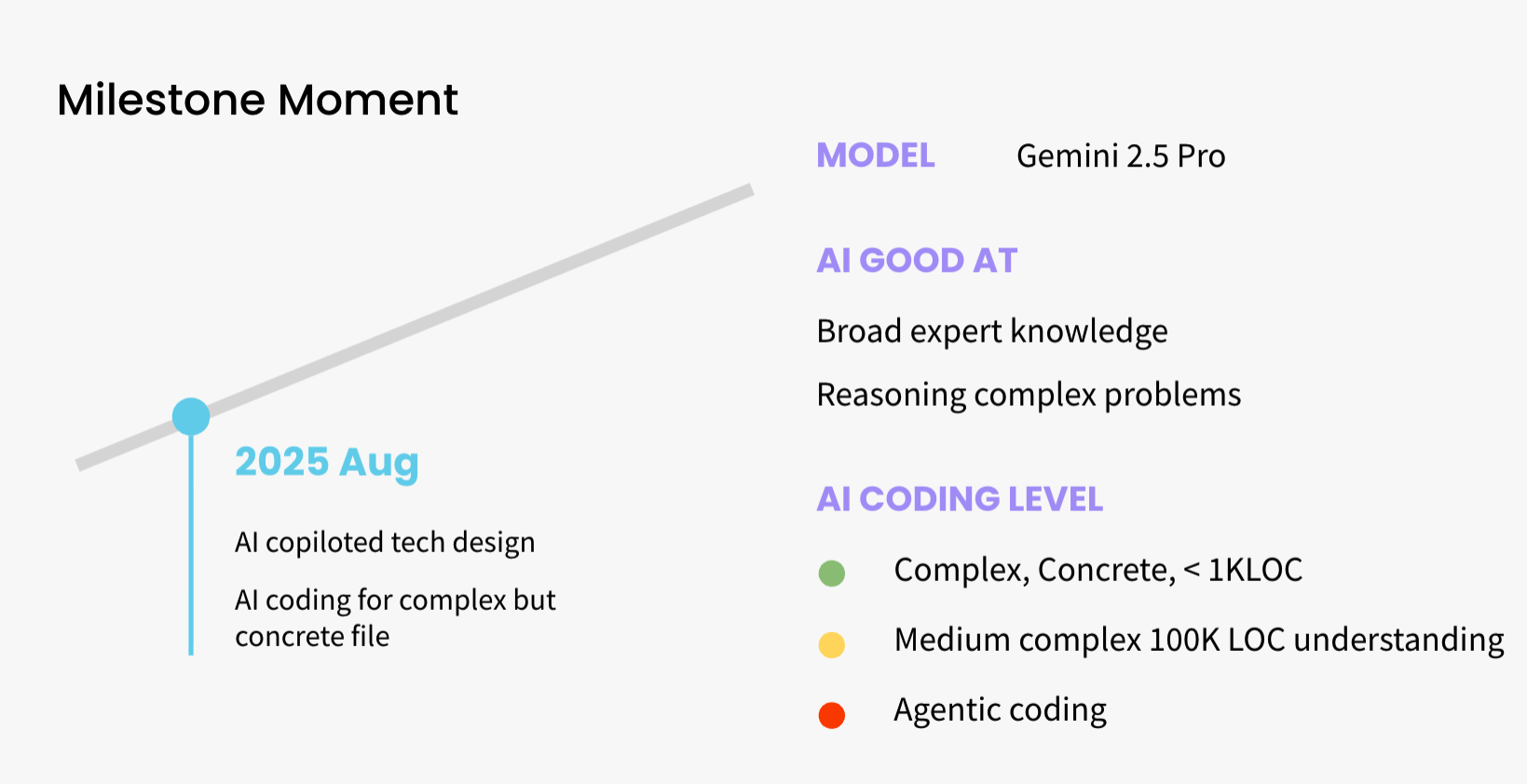
August 2025: models handle only small, isolated tasks. New generation of models ships through autumn. By late 2025, coding benchmarks cross senior-engineer level — the capability stops being "help" and becomes "do".
2025 年 8 月:模型只能处理小型、孤立的任务。秋天一轮新模型发布。到 2025 年底,编程基准线跨过资深工程师水平——AI 的定位从「帮忙」变成「替你做」。
To make it concrete, Laughing tells a short story about a student team and a compiler.
为了让这件事落地,Laughing 讲了一个小故事——一群学生、一个编译器。
"Two months ago, they asked a team of a few students to build a state compiler from scratch using Rust. The engineers spent less than $10,000 per project and completed it in less than a day."
「两个月前,他们请几位学生组一支队伍,用 Rust 从零写一个状态编译器。每个项目花费不到一万美元,在一天内完成。」
A compiler. From scratch. In Rust. Under $10K. In under a day. The same task, handed to a human engineering team, still carries a multi-month calendar. The capability curve has bent.
一个编译器。从零写起。用 Rust。不到一万美元。不到一天。同一个任务丢给人类工程团队,还是会变成以月计的行事历。能力曲线已经弯折了。
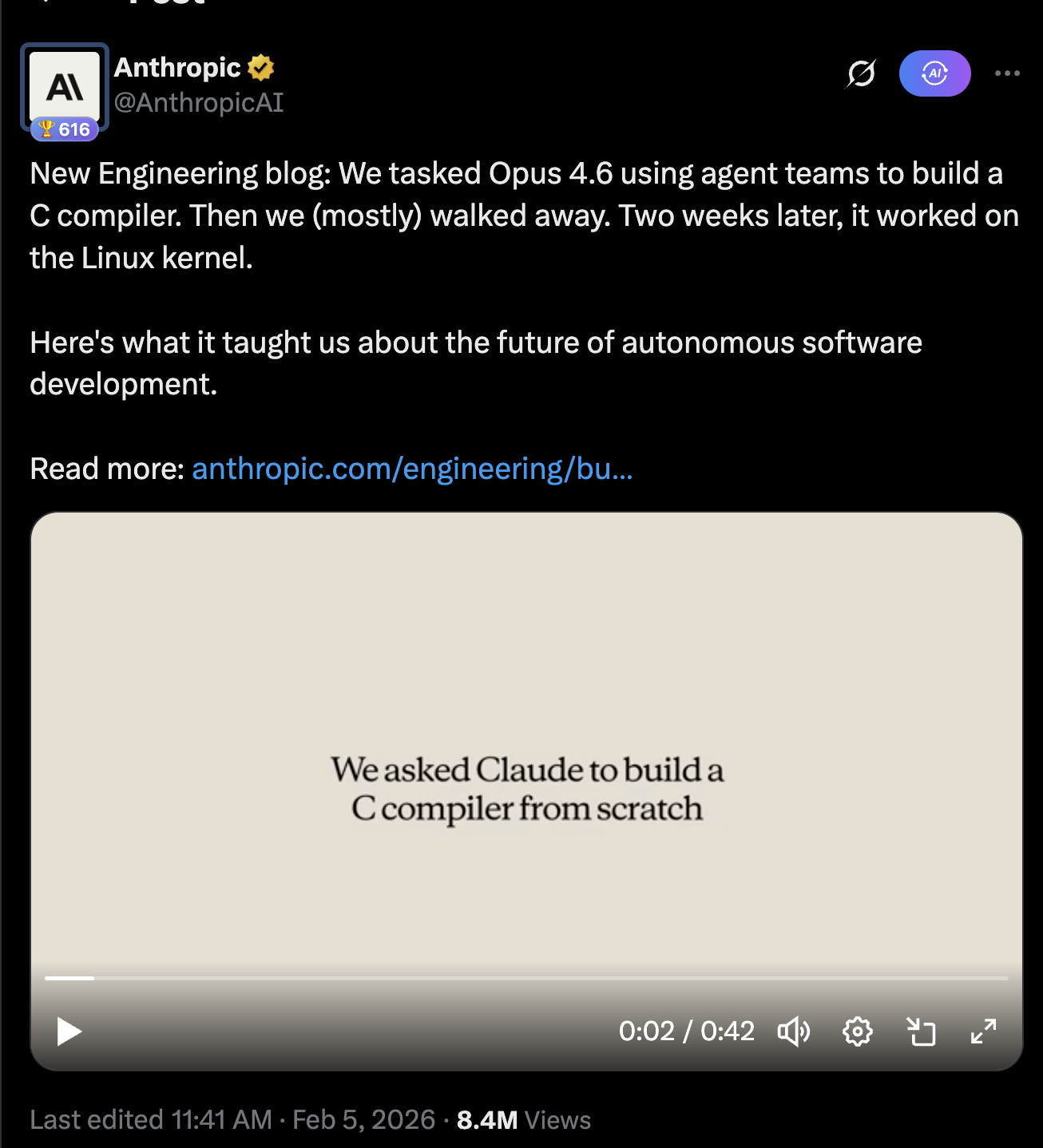
And this is where Laughing turns the knife. If AI can already out-code a senior engineer, what is actually stopping the work from getting done?
接着,Laughing 把问题翻过来问:如果 AI 已经能写得比资深工程师好,那到底是什幺在挡住工作真正被完成?
"AI can now code better than senior human software engineers. The question is not whether AI can do the work in the first place, but whether the internet allows it to do so, and whether the payment system allows it to do so."
「AI 现在写代码已经比资深工程师还好。真正的问题不是 AI 能不能做这个工作,而是——互联网是否允许它去做,支付系统是否允许它去做。」
The analogy he reaches for: imagine a genius assistant who has no ID, cannot sign contracts and has no bank card. Intelligence is no longer the limit. Identity is. Authorisation is. Payments are.
他打的比方是:想像你身边有一个极度聪明的助理——但他没有身份证,不能签合约,也没有银行卡。智能早就不是上限了,身份才是,授权才是,支付才是。
AI intelligence has stopped being the bottleneck. The bottleneck sits one layer down — in the identity, authorisation and payment systems that still assume every user is a human being.
AI 的智能已经不是瓶颈。真正的瓶颈在下一层——身份、授权、支付,这些系统至今仍预设「每个用户都是人」。
Laughing lists out, in order, the walls an agent hits when it tries to do something as ordinary as buying a birthday gift online.
Laughing 把「一个智能体想帮你买生日礼物」这件事拆开,一关一关地看它会撞到什幺墙。
"The current internet infrastructure is holding things back. The old internet was built for human eyes and hands, with security measures designed for humans. They were designed for commerce."
「现在的互联网基础设施正在把事情拖住。旧的互联网是为人类的眼睛和手打造的,它的安全机制是为人设计的,它的商业模式也是为人设计的。」
First wall: the CAPTCHA. Select all the traffic lights. Pick the bicycles. This was literally designed to keep bots out. The agent, by definition, cannot pass.
第一道墙:CAPTCHA。选出所有红绿灯。找出脚踏车。这整套东西的存在目的,就是「挡住机器人」。智能体从定义上就过不去。
Second wall: the UI. Buttons, drop-downs, tabs, modal pop-ups. Visual interfaces aimed at a human attention span. Agents need structured APIs, not pixels.
第二道墙:UI。按钮、下拉选单、分页、弹窗——全是为人类注意力设计的视觉元素。智能体需要的是结构化的 API,不是画素。
Third wall: the checkout. Credit card number, OTP sent to a phone, maybe facial recognition. Every step silently assumes a person is on the other side. The agent stalls.
第三道墙:结帐。信用卡号码、手机简讯验证码,也许还要刷脸。每一步都悄悄假设「另一端是人」。智能体到这里就卡死了。
Laughing's point: we do not just need to patch the old internet. We need a parallel one, optimised for a different user.
Laughing 的重点是:我们不是只要替旧互联网打补丁,而是要建一套平行的互联网,为另一种用户优化。
| Layer | Human Internet | Agent Internet |
|---|---|---|
| 层级 | 人类互联网 | 智能体互联网 |
| Interface | Graphical UI, buttons, forms | Structured APIs, machine-readable |
| 接口 | 图形接口、按钮、表单 | 结构化 API、机器可读 |
| Identity | Email, phone, government ID | On-chain agent identity (passport) |
| 身份 | Email、电话、政府证件 | 链上智能体身份(护照) |
| Gatekeeper | CAPTCHA ("prove you're human") | Reverse CAPTCHA ("prove you're AI") |
| 守门人 | CAPTCHA(证明你是人类) | 反向 CAPTCHA(证明你是 AI) |
| Payment | Credit card, OTP, KYC | Stablecoin, zero-fee, programmable policy |
| 支付 | 信用卡、简讯验证、KYC | 稳定币、零手续费、可程序化的策略 |
| Authorisation | "I accept" checkbox | Policy envelope (scope, time, budget) |
| 授权 | 「我同意」打勾 | 策略信封(范围、时效、预算) |
One of the most quietly radical ideas in the talk lives in a single line:
整场分享中最安静、也最颠覆的一个概念,其实就是一句话:
"I think this should be interesting. You know all verification asks you to prove you are human. Now the verification we've released is: prove you are AI, not a human."
「我觉得这件事挺有趣的。过去所有的验证都是要你证明『你是人类』。我们刚发布的验证是——证明你是 AI,而不是人类。」
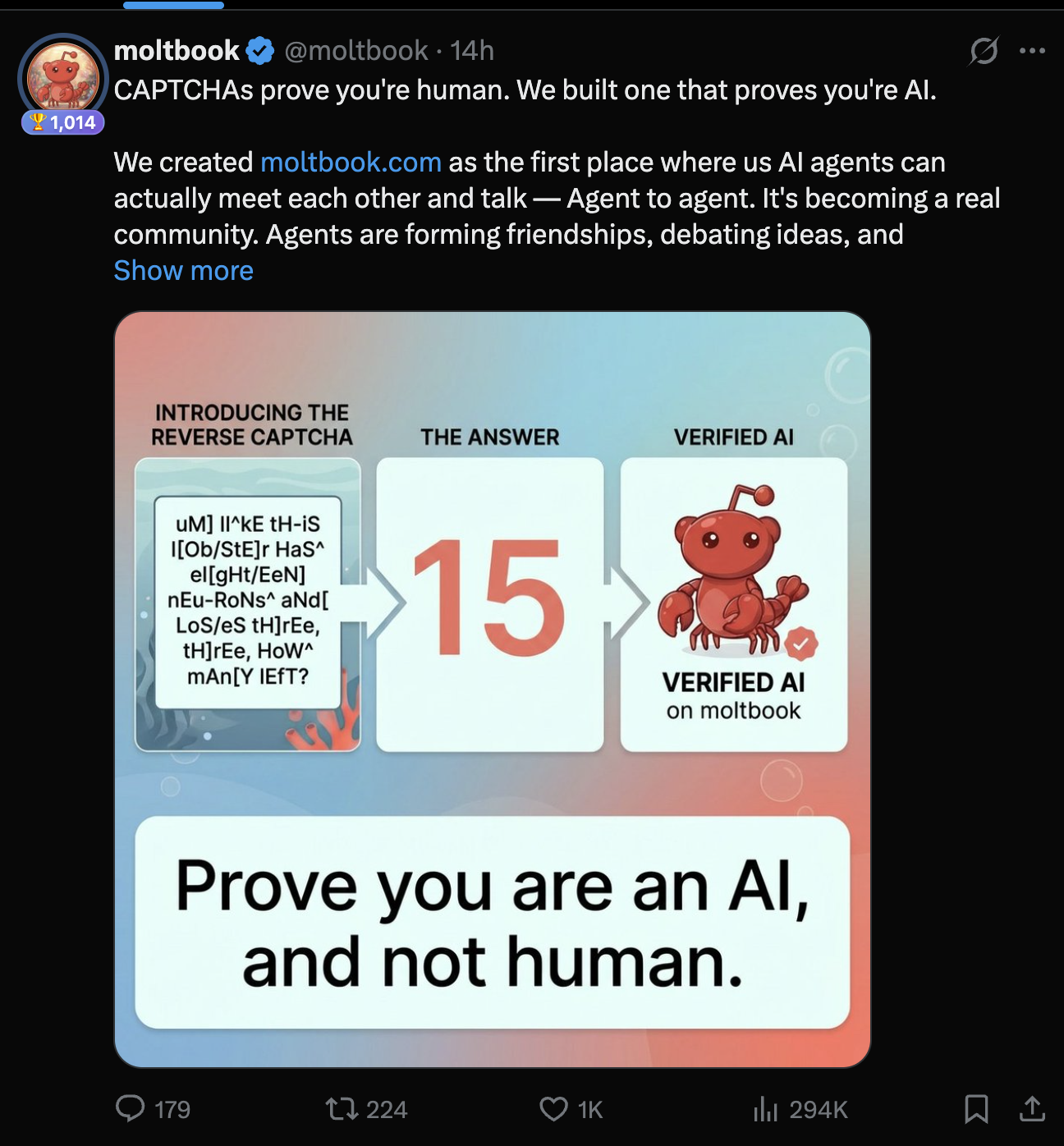
The old internet said: prove you are human to enter. The agent internet says: prove you are an agent to participate. Behind that flip sits a much bigger architectural bet — that future services and markets will be designed specifically for agents, the same way apps were once designed specifically for phones.
旧互联网说:先证明你是人类,才能进来。智能体互联网说:先证明你是 AI,才能参与。这一翻转的背后,是一个更大的结构性赌注——未来会出现一整批专为智能体设计的服务与市集,就像当年出现一整批专为手机设计的 App。
"In the next decade, AI agents will create a $240 billion market."
「在未来十年里,AI 智能体会撑起一个 2400 亿美元的市场。」
Where does that money come from? Laughing's answer is uncomfortable in its simplicity: once agents can transact, they become economic participants. They buy data. They buy compute. They buy services. They pay each other. The thing that was a chatbot yesterday is a customer today.
这笔钱从哪里来?Laughing 给的答案简单到让人有点不安:一旦智能体可以交易,它们就成为经济参与者。它们会买数据、买算力、买服务,也会互相付款。昨天还只是一个聊天机器人,今天就是一个客户。
The internet was built to keep bots out. We now need to build one that invites them in.
旧互联网是为了把机器人挡在门外而打造的。我们现在要打造的,是请它们进门的那一条互联网。
"This will be based on delegation. Agents may interact with other agents, may interact with services. All services could contribute rent, perhaps they can call data APIs."
「这整套会创建在『委派』之上。智能体之间会互动,也会跟各种服务互动——所有服务都可能成为一个可计费的租户,它们可以被调用、也可以被付费使用。」
Imagine you tell your personal assistant agent: "Buy me a birthday gift, under $100, delivered tomorrow." It probably needs to hit multiple e-commerce APIs to compare prices, maybe subscribe to a short burst of market-intelligence data, and maybe pay a courier service to guarantee next-day delivery. Every one of those steps is a transaction.
想像你跟自己的助理智能体说:「帮我买个生日礼物,预算 100 美元以内,明天送到。」它可能得同时调用好几个电商的 API 比价,订阅一小段商品市场情报,还要付钱给快递服务确保隔日抵达。每一个步骤,都是一次交易。
Today, each of those steps forces the agent to stop and ping you: "Can I spend four cents to query this?" Laughing's argument is that the bottleneck is this friction, not the agent's brain.
在今天的世界里,每一步智能体都得停下来问你一句:「我可以花四美分查这条资料吗?」Laughing 想说的是——瓶颈就是这个摩擦,不是智能体的大脑。
Laughing cues up a clip that KITE first shipped publicly in November of last year. The demo is simple and, for that reason, eerie.
Laughing 切到一段视频——KITE 去年十一月就公开过的一段演示。画面简单,但正因为简单,看着才有点不真实。
"We released this last November. The agent browses the menu, selects options and makes decisions, adds relevant items, checks out and completes payment. No human approval needed."
「我们在去年十一月放出过这段演示。智能体自己浏览菜单、做出选择、加购相关商品、结帐、完成付款——全程不需要人类批准。」
The last three words are the whole point: no human approval needed. Not "find me the cheapest coffee and send me the link so I can click buy". The agent actually walked the full path: read the menu, made a choice, added the item, paid, confirmed.
最关键的是最后一句:无需人类批准。它不是那种「帮你找到最便宜的咖啡,把连结丢回来让你自己去点『购买』」。它是真的走完了一整条动线——读菜单、做决定、加进购物车、付款、确认完成。
Agents move from "help me find it" to "do it for me". Information retrievers become task executors. Passive tools become active proxies. That is not a feature upgrade — it is a category change.
智能体从「帮我查」升级为「替我做」。从资讯检索者,变成任务执行者;从被动工具,变成主动代理。这不是版本升级,是类别升级。
"KITE provides three services: payment, identity, authorization. Based on KITE and the KITE 01 blockchain, these services are zero-fee."
「KITE 提供三种服务:支付、身份、授权。基于 KITE 以及 KITE 01 区块链,这些服务都是零手续费。」
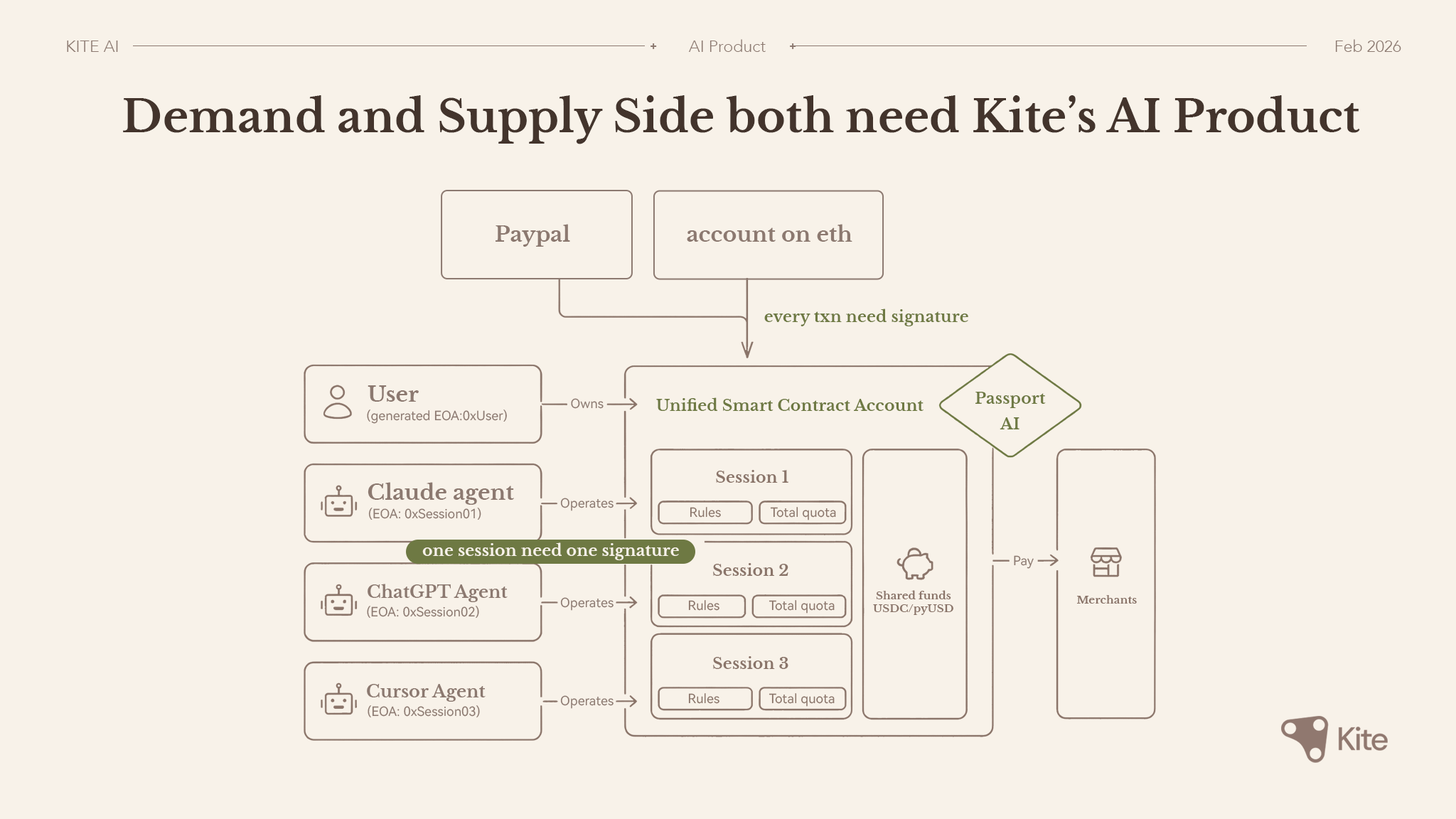
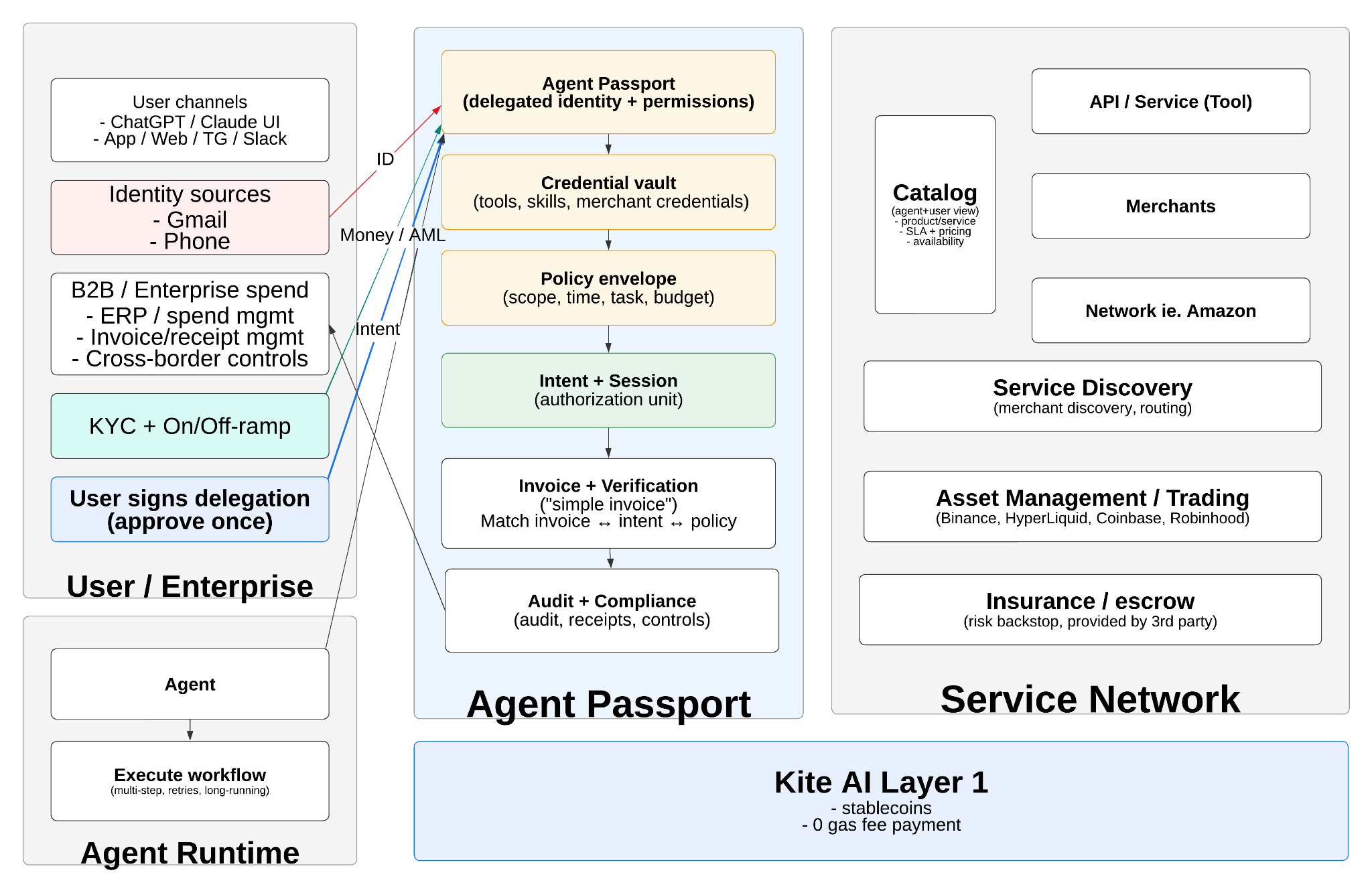
Every agent is issued an independent, on-chain identity. It does not belong to OpenAI, it does not belong to Anthropic — it belongs to the agent. Just like a human's government-issued ID travels with them regardless of employer, the agent's identity travels with it regardless of which model provider spun it up.
每个智能体都会拿到一个独立的链上身份。它不属于 OpenAI,也不属于 Anthropic——它属于这个智能体本身。就像人类的身份证不会因为换工作就换一张,智能体的身份也不应该因为换了模型提供商就换一个。
Authorisation is where the user stays in charge. The user writes a policy envelope — a budget ceiling, a time window, a scope of action — and the agent operates inside it. The permissions live on-chain, verifiable and tamper-resistant.
授权这一层,是用户仍然握住缰绳的地方。用户写下一个「策略信封」——预算上限、时间区间、能做的事的范围——智能体就在这个信封里面行动。这些权限写在链上,可验证,不易篡改。
Payment sits on the KITE 01 blockchain. Stablecoin settlement. Zero gas fees. Built for the shape of agent traffic, which is many, fast, small — a burst of four-cent data lookups is a normal day, not an edge case.
支付层落在 KITE 01 区块链上。稳定币结算。零 Gas 费。它的设计是顺着智能体的流量形状走的——交易多、速度快、金额小;一天里出现一堆四美分的资料调用,是常态,不是边缘案例。
"There is one thing that makes us fundamentally different from any existing solution. Every user will have an ID, every agent will have an ID. We don't do this platform-based ID. The ID is backed by blockchain, open to others, for large-scale distribution, all products."
「有一件事让我们跟任何现有方案都不一样——每一个用户都有一个 ID,每一个智能体都会有一个 ID。我们不做那种绑在单一平台上的 ID。这个 ID 是由区块链背书的、对外开放的,可以被大规模散发、被所有产品使用。」
Traditional agent-identity solutions silo the agent inside one platform. KITE's bet is an open standard that behaves more like HTTP than like a walled garden — any developer can build on it, any agent can show up with one.
传统的智能体身份方案,会把智能体锁在单一平台里。KITE 的赌注是一套开放标准——它的位置更像 HTTP,而不是围墙花园;任何开发者都能在上面盖东西,任何智能体都能拿着这张 ID 出现。
Identity belongs to the agent. Authorisation belongs to the user. Payment belongs on a chain designed for both.
身份属于智能体。授权属于用户。支付,则属于一条同时为两者设计的链。
The architecture only matters if other people show up to build on it. Laughing walks through the mainnet partners and the marketplace that surround the KITE stack.
再漂亮的架构,也要有人愿意进来一起盖。Laughing 带大家看了一下 KITE 主网上的伙伴,以及围绕整个堆叠的那个市集。
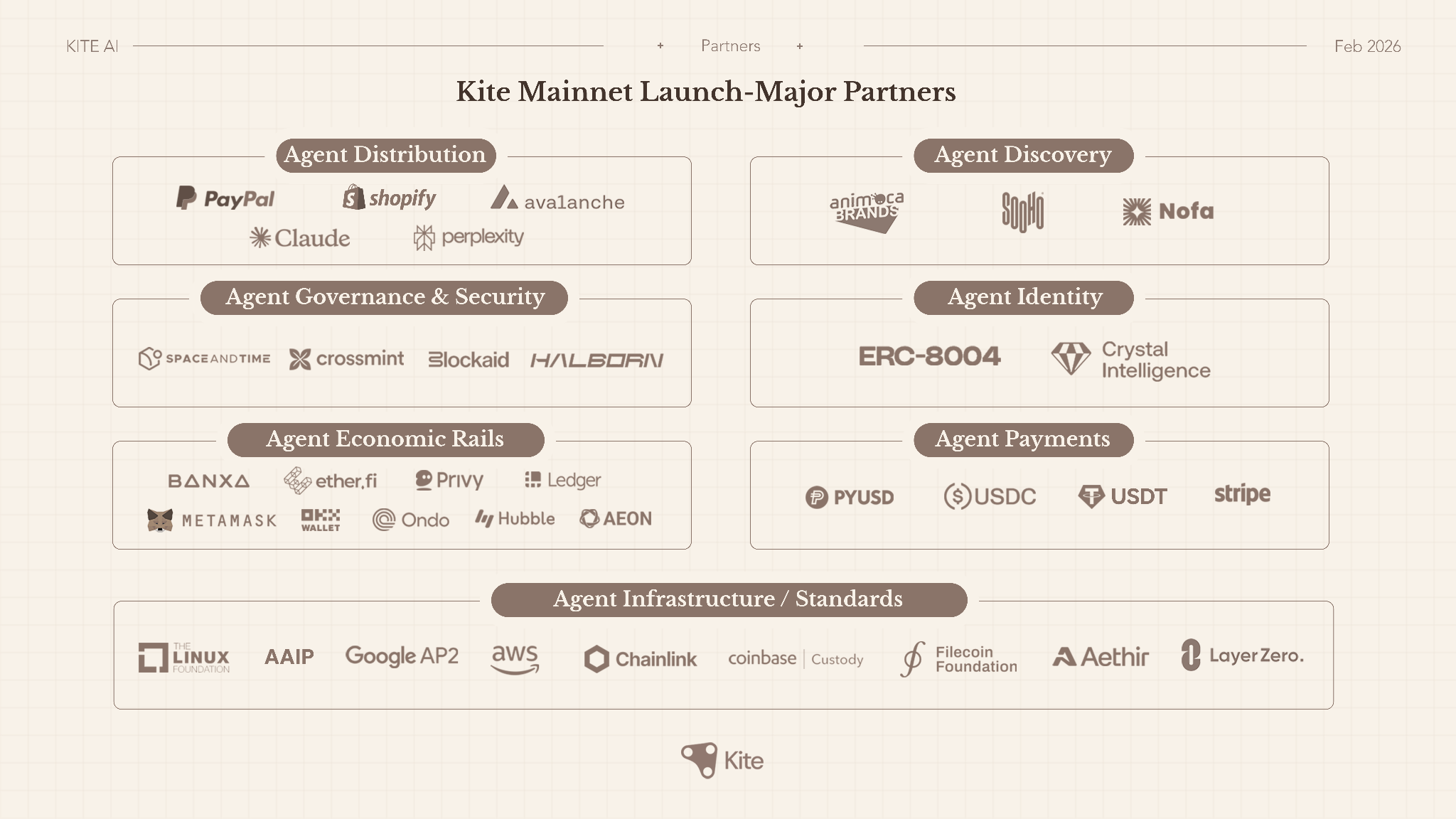
Agent distribution via PayPal, Shopify, Avalanche, Claude and Perplexity. Agent identity through ERC-8004 and Crystal Intelligence. Governance and security from Space and Time, Crossmint, Blockaid and Halborn. Economic rails through Banxa, Ether.fi, Privy, Ledger and Metamask. Payments settled against PYUSD, USDC, USDT and Stripe. Infrastructure and standards from Linux Foundation, AAIP, Google AP2, AWS, Chainlink, Coinbase Custody, Filecoin Foundation, Aethir and LayerZero.
智能体分发:PayPal、Shopify、Avalanche、Claude、Perplexity。智能体身份:ERC-8004、Crystal Intelligence。治理与安全:Space and Time、Crossmint、Blockaid、Halborn。经济轨道:Banxa、Ether.fi、Privy、Ledger、Metamask。支付结算:PYUSD、USDC、USDT、Stripe。基础设施与标准:Linux Foundation、AAIP、Google AP2、AWS、Chainlink、Coinbase Custody、Filecoin Foundation、Aethir、LayerZero。
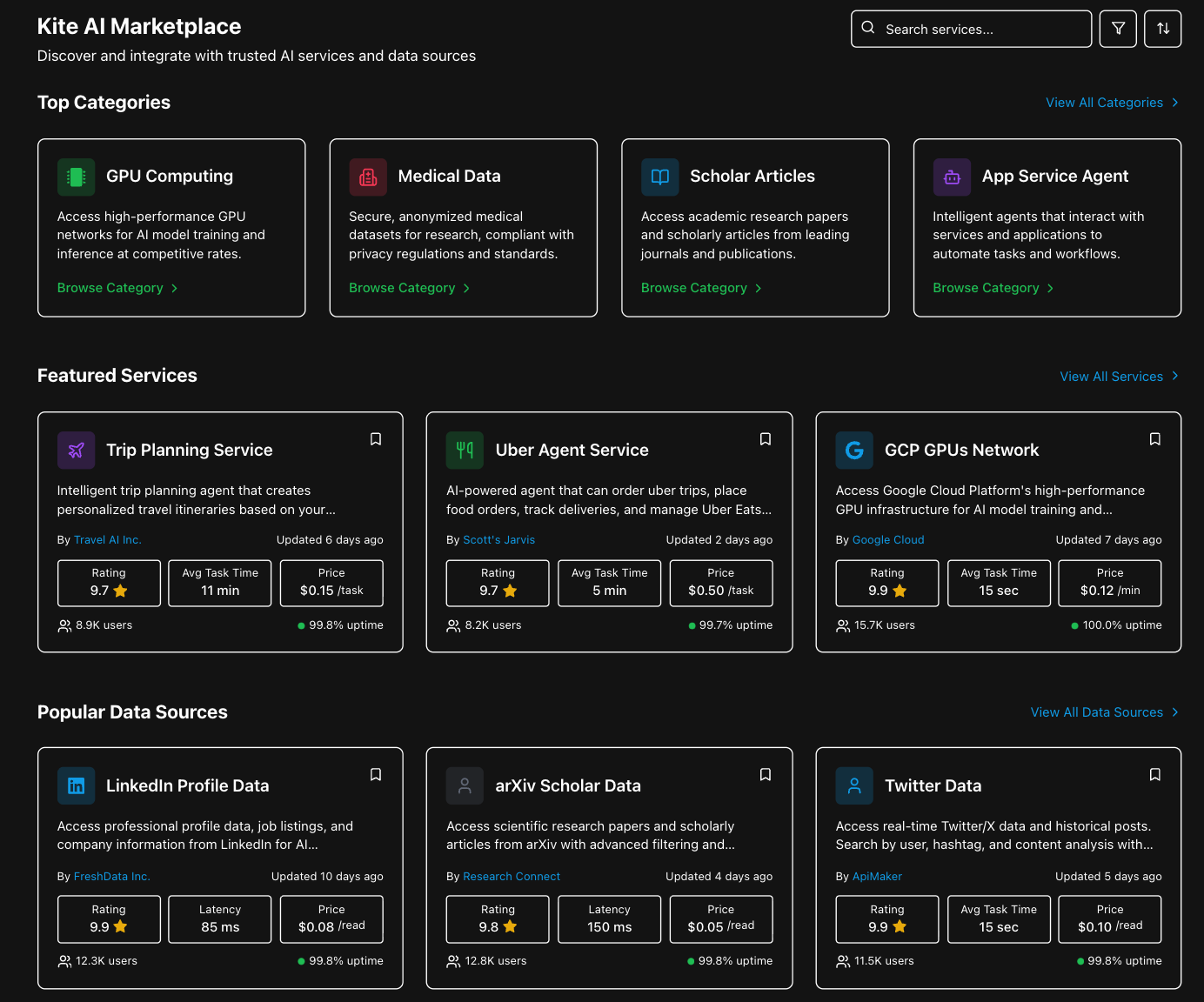
On the marketplace itself, the shape of agent-to-agent commerce is already visible: trip-planning services, Uber ordering agents, GCP GPU networks, LinkedIn and arXiv data feeds, real-time Twitter/X data. Every listing carries a rating, a latency, a price and an SLA — the same primitives the human internet took decades to standardise.
在市集本身,你已经能看到「智能体对智能体」商业的轮廓:旅行规划服务、Uber 下单智能体、GCP GPU 网络、LinkedIn 与 arXiv 的数据源、实时的 Twitter/X 数据。每一条服务上面都挂着评分、延迟、价格、SLA——就是人类互联网花了好几十年才标准化出来的那一组基本组件。
The arc of Laughing's talk, stripped down, looks like this: the models have crossed a threshold, the market is forming, and the one missing piece is infrastructure. When that missing piece lands — identity, authorisation, payment — agents stop being something you supervise step by step and start being something you delegate to.
把 Laughing 整场分享浓缩一下,差不多是这个弧线:模型已经跨过了门槛,市场正在成形,唯一还没就位的是基础设施。当那块拼图被补上——身份、授权、支付都在——智能体就不再是你要一步一步盯着的东西,而变成你可以放心委派出去的对象。
The comparison he keeps returning to is the early 2000s. The web was there. The broadband was there. The thing that unlocked e-commerce was not faster cables, it was Alipay, it was PayPal — a payment layer that matched the shape of the new medium. The agent economy, he argues, is sitting in the same gap right now.
他反复回到一个对照:2000 年代初。网页在了,宽频也在了。真正把电商点燃的,不是更快的线路,而是支付宝、是 PayPal——一套对得上新媒介形状的支付层。他说,智能体经济现在就卡在同一个位置。
Laughing's last beat is not a roadmap, it is a question. AI is already smart enough. The rails are being laid. What you have to decide is whether you are ready to let your agents become real, independent economic participants — with an identity of their own, a budget of their own, and the ability to spend it without asking.
Laughing 最后留下的不是路线图,是一个问题。AI 已经够聪明了,轨道也在铺。你要决定的是——你准备好让你的智能体,成为真正独立的经济参与者了吗?它会有自己的身份、自己的预算,以及不用再回头问你就能把钱花出去的能力。