Seb opens with a warning, not a sales pitch.
Seb 以一个警告开场,而不是推销。
"This is my friend's situation this morning. She was using OpenClaw, and when she went to sleep, OpenClaw basically burned through a lot of credits. Her OpenRouter account basically went from $5 to zero."
"这是我朋友今天早上的情况。她在用 OpenClaw,当她去睡觉时,OpenClaw 基本上烧掉了大量额度。她的 OpenRouter 帐户从 5 美元直接归零了。"
Overnight, $5 burned to nothing. This wasn't a hypothetical risk. It literally happened that morning. Seb's friend left an agent running unchecked while she slept. She woke up to a zero balance.
一夜之间,5 美元烧成了零。这不是假设的风险,是当天早上真实发生的事。Seb 的朋友让智能体在无人看管的情况下运行了一晚,醒来发现余额归零。
That's Seb's first lesson: if you don't configure your agents properly, this will happen to you.
这是 Seb 的第一课:如果你不正确配置你的智能体,这种事就会发生在你身上。
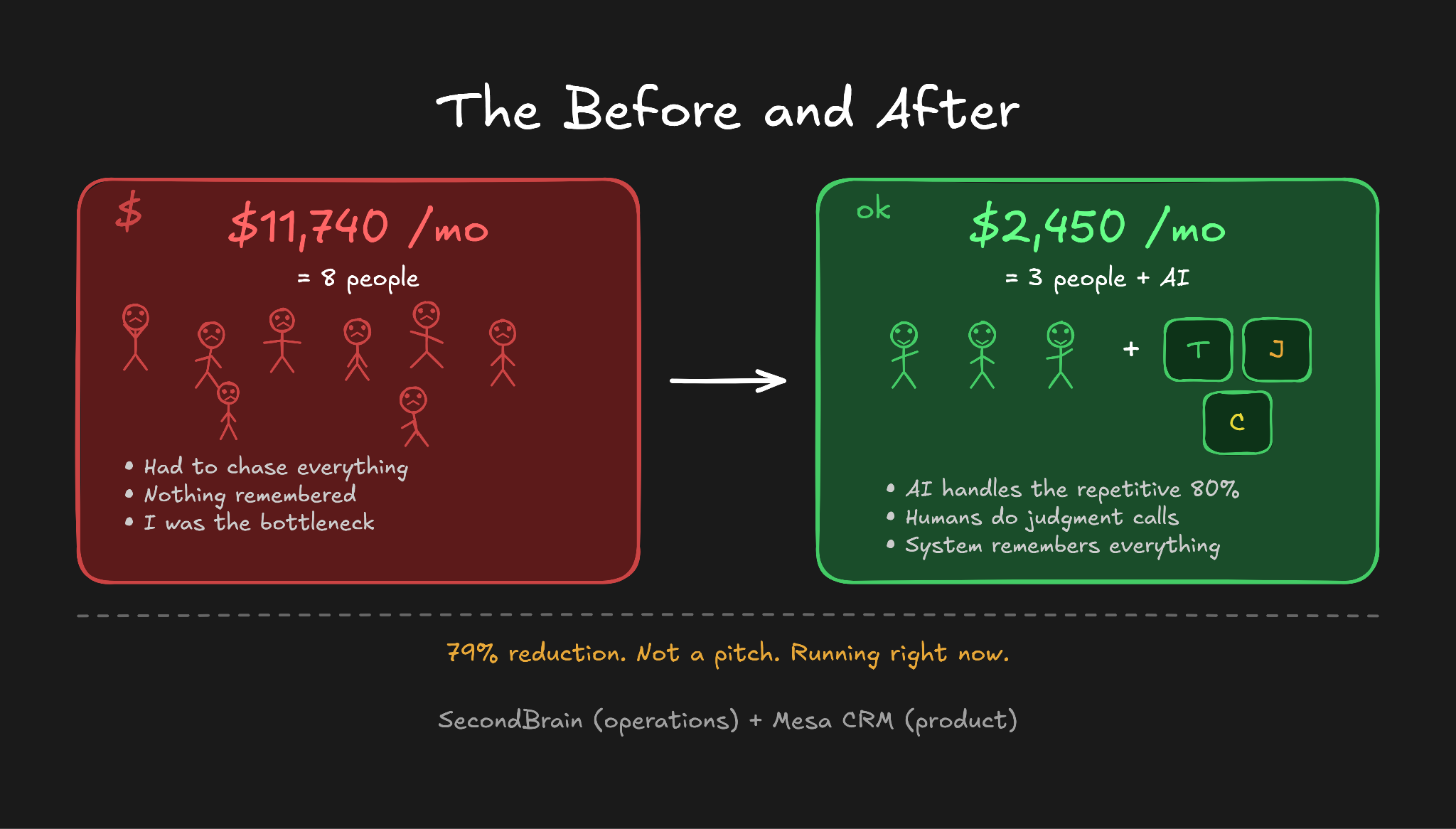
But this talk isn't meant to scare you. What Seb is about to share is how he used AI agents to cut operating costs from $11,000/month to $2,400/month, a 78% reduction, while managing two companies at the same time. This isn't theory. This is battle-tested.
但这次分享并不是为了吓唬你。Seb 要分享的是他如何用 AI 智能体将运营成本从每月 11,000 美元降低到 2,400 美元——降幅 78%,同时管理两家公司。这不是理论,这是实战验证过的。
Seb's startup journey went through several pivotal turns.
Seb 的创业之旅经历了几个关键转折。
"Before this, I was actually managing a 17-person team. Then after a while, when the market went down, I cut it to 8. Then I realized this huge AI thing is happening... I realized this AI thing is actually powerful."
"在这之前,我实际上管理着一个 17 人的团队。后来市场下行,我裁减到 8 人。然后我意识到 AI 这件大事正在发生……我意识到 AI 确实很强大。"
From a 17-person team before 2023, to 8 during the downturn, to an AI-augmented operation in 2024 and beyond. Seb eventually brought monthly costs down to $2,400. Compared to the previous $11,000, that's a staggering 78% cut.
从 2023 年前的 17 人团队,到低迷期的 8 人,再到 2024 年及之后的 AI 增强运营。Seb 最终将月度成本降至 2,400 美元。与之前的 11,000 美元相比,降幅高达 78%。
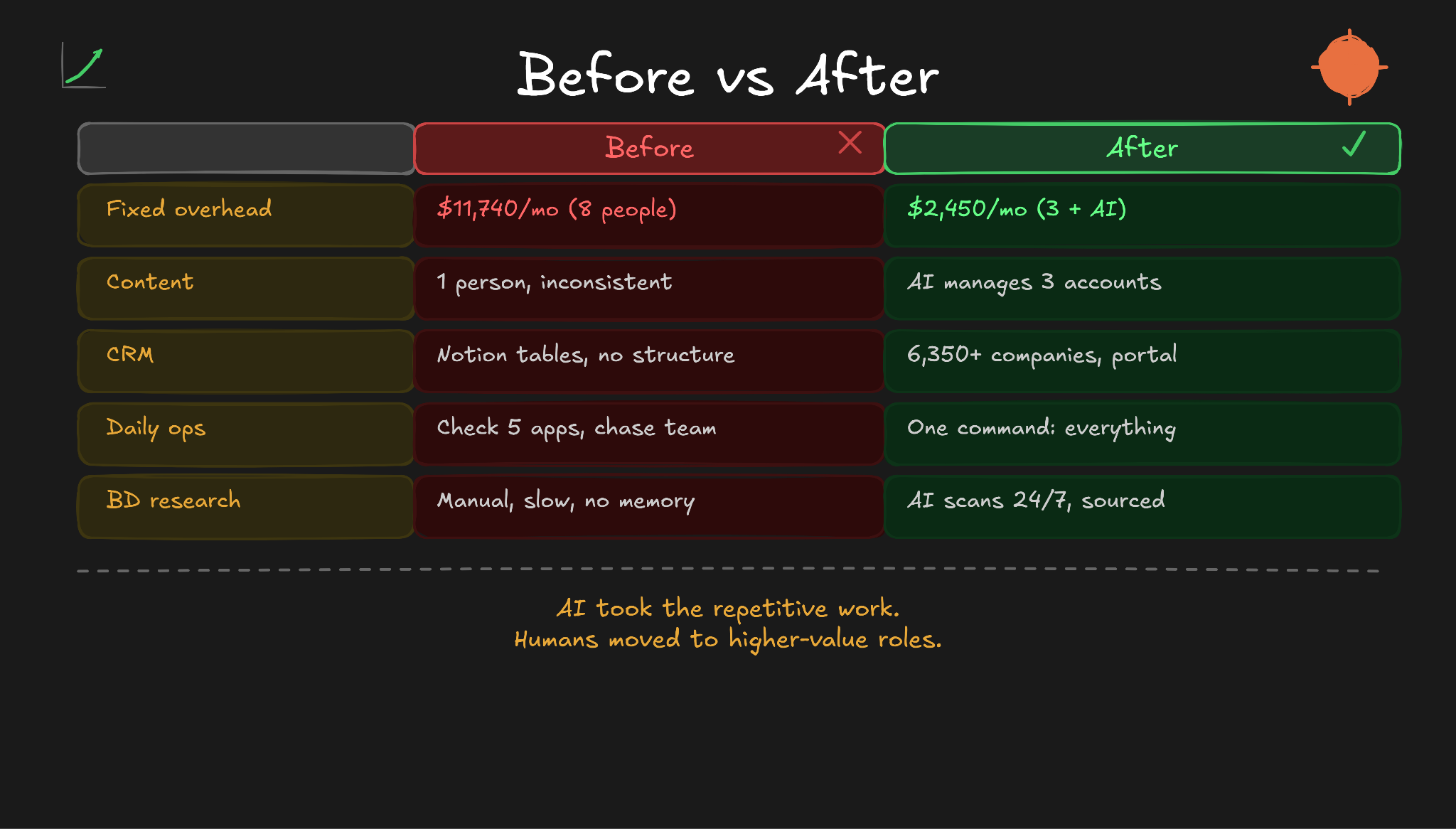
| Category | Before | After |
|---|---|---|
| 类别 | 之前 | 之后 |
| Fixed Costs | $11,740/mo (8 people) | $2,450/mo (3 people + AI) |
| 固定成本 | $11,740/月(8 人) | $2,450/月(3 人 + AI) |
| Content Mgmt | 1 person, inconsistent | AI manages 3 accounts |
| 内容管理 | 1 人,不稳定 | AI 管理 3 个帐户 |
| CRM | Notion tables, no structure | 6,350+ companies, pro portal |
| CRM | Notion 表格,无结构 | 6,350+ 公司,专业门户 |
| Daily Ops | Check 5 apps, chase the team | One command: get it done |
| 日常运营 | 检查 5 个应用,催促团队 | 一条命令:搞定一切 |
| BD Research | Manual, slow, no memory | AI 24/7 scanning, sourced |
| BD 调研 | 手动、缓慢、无记忆 | AI 全天候扫描,有据可查 |
AI took over the repetitive work. Humans focus on high-value decisions.
AI 接管了重复性工作,人类专注于高价值决策。
What makes the costs so low is equally surprising:
成本如此之低的原因同样令人意外:
"Why is the cost so low? Because I'm not really hiring in Singapore. Most of my manpower is usually in other Southeast Asian countries."
"为什幺成本这幺低?因为我并没有在新加坡招人。我的大部分人力通常在其他东南亚国家。"
Seb's strategy is pragmatic: tap into excellent, cost-effective talent across Southeast Asia, then combine that with AI agents to create an optimal cost structure. This is real founder wisdom: achieving goals with smart resource allocation when resources are limited.
Seb 的策略很务实:利用东南亚优秀且性价比高的人才,再结合 AI 智能体创建最优成本结构。这是真正的创始人智能:在资源有限时通过智能资源配置实现目标。
AI took over the repetitive work. Humans focus on high-value decisions. That is the whole game.
AI 接管重复工作。人类专注于高价值决策。整场游戏就是这样。
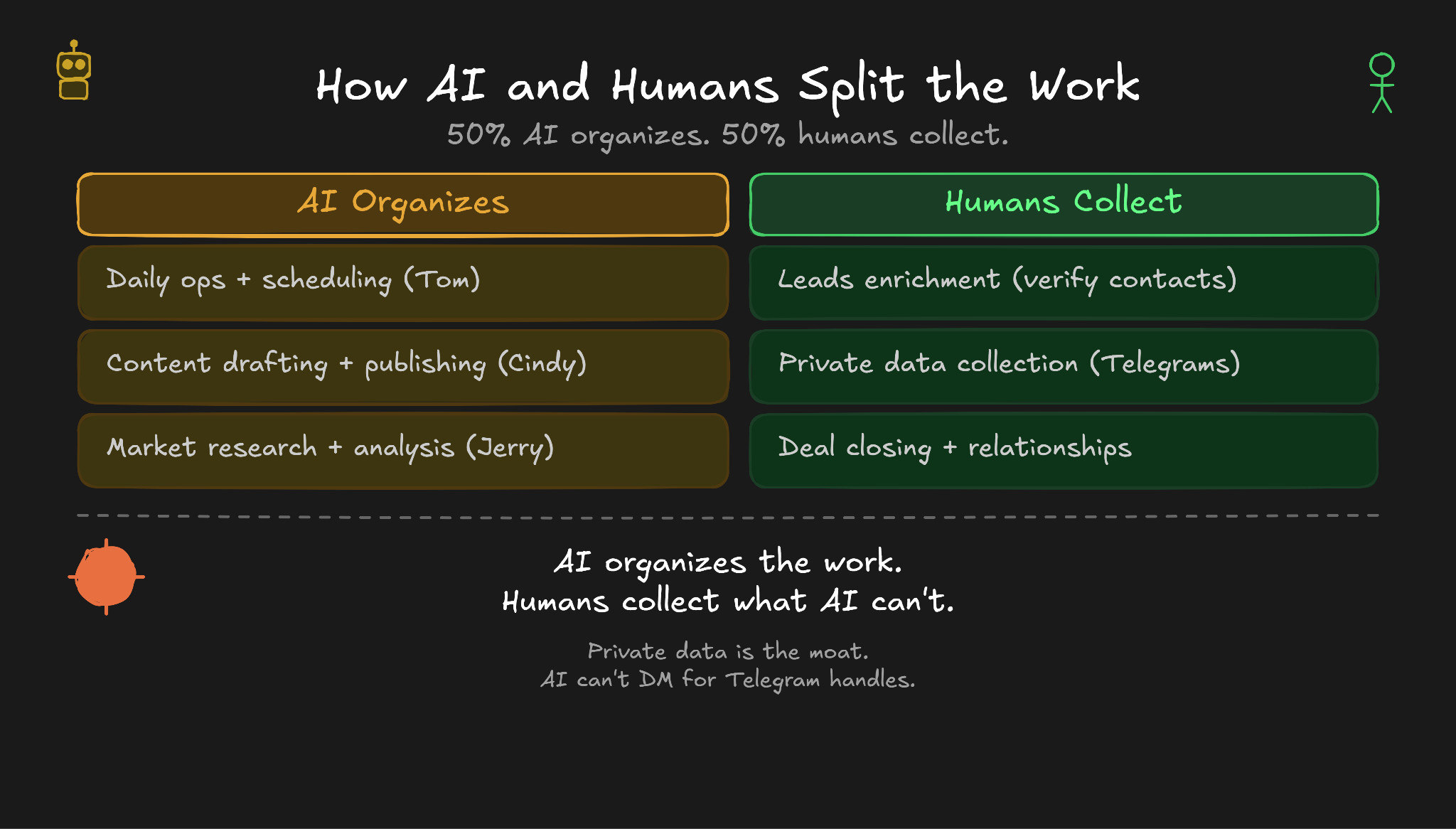
What AI organizes: daily ops + scheduling (Tom), content drafting + publishing (Cindy), market research + analysis (Jerry).
AI 负责组织:日常运营 + 日程安排(Tom),内容撰写 + 发布(Cindy),市场调研 + 分析(Jerry)。
What humans collect: lead enrichment (verifying contacts), private data collection (Telegram), deal closing + relationship building.
人工负责采集:线索补充(验证联系人),私域数据采集(Telegram),成交 + 关系建设。
Private data is the moat. AI can't DM a Telegram account.
私域数据就是护城河。AI 无法给 Telegram 帐户发私信。
Tom is the core of the entire system, the only agent directly connected to Seb.
Tom 是整个系统的内核,唯一直接与 Seb 连接的智能体。
"Tom is actually my current chief of staff. He's basically the only one connected to my Telegram."
"Tom 实际上是我目前的首席幕僚。他基本上是唯一连接我 Telegram 的智能体。"
Tom runs on a strict schedule. At 8 AM, he sends the morning briefing: today's to-dos, important reminders, and a market overview. At noon, he checks if anything needs attention. At 6 PM, he sends the daily report summarizing completed tasks and data. At 9 PM, he prepares tomorrow's plan and priorities.
Tom 按严格的时间表运行。早上 8 点,发送晨间简报:今日待办、重要提醒和市场概况。中午,检查是否有需要关注的事项。下午 6 点,发送日报总结已完成任务和数据。晚上 9 点,准备明天的计划和优先事项。
It's like having an assistant who never sleeps, managing your schedule and priorities 24/7.
就像有一个永不睡觉的助理,全天候管理你的日程和优先事项。
Jerry exists because of a critical insight: AI agents have a fatal flaw: they love to make assumptions.
Jerry 的存在源于一个关键洞察:AI 智能体有一个致命缺陷——它们喜欢做假设。
"The problem with agents is most of them like to make assumptions. When they make assumptions, you don't know. That's the big problem."
"智能体的问题是大多数都喜欢做假设。当它们做假设时,你并不知道。这才是大问题。"
When an agent assumes a data point and you don't realize it's just an assumption, the consequences can be severe:
当智能体假设一个数据点而你没有意识到那只是假设时,后果可能很严重:
"If you make a wrong assumption and you use a wrong number when talking to a client, you'll basically destroy the deal."
"如果你做了错误的假设,在跟客户谈话时用了错误的数字,你基本上就毁掉了这笔交易。"
That's Jerry's value. His entire scope is to ensure agents conduct proper research, research based on actual online sources, not assumptions. All data must have verifiable online sources. Wrong data means losing clients, losing revenue. Jerry is the gatekeeper preventing that disaster.
这就是 Jerry 的价值。他的全部职责是确保智能体进行正确的调研——基于真实的网络来源,而非假设。所有数据必须有可验证的在线来源。错误数据意味着失去客户、失去收入。Jerry 是防止这种灾难的守门员。
Cindy handles all social media content creation and publishing.
Cindy 负责所有社交媒体内容的创作和发布。
"Cindy is my content master. Basically anything I want to post on LinkedIn, Twitter, Instagram, etc."
"Cindy 是我的内容大师。基本上我想发到 LinkedIn、Twitter、Instagram 等平台的任何内容都归她。"
Cindy's workflow demonstrates real intelligence. When Seb says "I want to post a tweet about AI agents," Tom calls Cindy. She then begins her research: scanning target platforms, analyzing audience interests, studying trending topics and styles, learning Seb's voice, and drafting content.
Cindy 的工作流展示了真正的智能。当 Seb 说"我想发一条关于 AI 智能体的推文"时,Tom 会调用 Cindy。她随即开始调研:扫描目标平台、分析受众兴趣、研究热门话题和风格、学习 Seb 的语气,然后起草内容。
The key: Cindy learns Seb's writing style, so the content sounds like Seb wrote it himself. Connected to Typefully via MCP (Model Context Protocol), Cindy auto-schedules and publishes. This isn't simple automation; it's a system that genuinely understands your style and audience.
关键在于:Cindy 会学习 Seb 的写作风格,所以内容听起来就像 Seb 亲自写的。通过 MCP(Model Context Protocol)连接到 Typefully,Cindy 自动排期并发布。这不是简单的自动化,而是一个真正理解你风格和受众的系统。
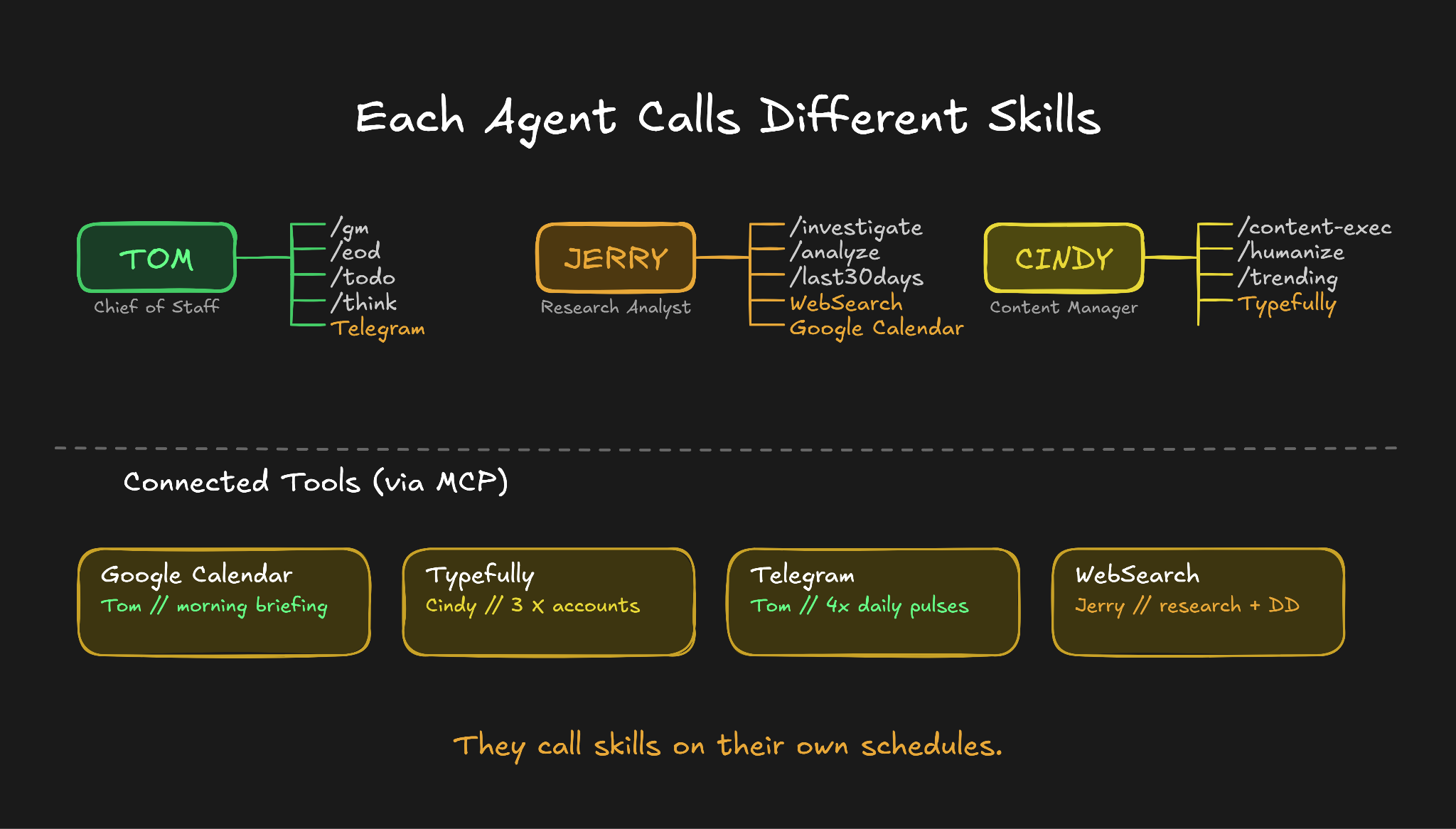
Agent skill mapping:
智能体技能映射:
/gm, /eod, /todo, /think, /telegram/gm、/eod、/todo、/think、/telegram/investigate, /analyze, /last30days, /websearch, Google Calendar/investigate、/analyze、/last30days、/websearch、Google Calendar/content-exec, /humanize, /trending, Typefully/content-exec、/humanize、/trending、TypefullyMCP-connected tools: Google Calendar (Tom // morning briefings), Typefully (Cindy // 3 accounts), Telegram (Tom // 4x daily pulse), WebSearch (Jerry // research + DD).
MCP 连接工具:Google Calendar(Tom // 晨间简报)、Typefully(Cindy // 3 个帐户)、Telegram(Tom // 每日 4 次脉搏)、WebSearch(Jerry // 调研 + DD)。
Seb demonstrated an impressive capability: controlling agents with voice.
Seb 展示了一项令人印象深刻的功能:用语音控制智能体。
"This is an example. This is actually Tom. Basically what I do is use my phone, voice-record what I want... I send it, then it goes through a thinking process, calls tools, runs commands, and outputs the entire framework."
"这是一个例子。这其实就是 Tom。我基本上就是用手机,语音录制我想要的内容……发送出去,然后它经过思考过程,调用工具,运行命令,输出整个框架。"
Picture this: you tell your phone, "Tom, prepare materials for tomorrow's meeting with XYZ Company." Tom receives and processes. You can see the entire workflow: "Thinking..." "Calling tool: client_memory" "Running command: analyze_meeting_history" "Generating framework..." Finally, it outputs the meeting prep doc, a client history summary, suggested talking points, and potential questions with response strategies.
想像一下:你对手机说"Tom,为明天和 XYZ 公司的会议准备材料。"Tom 接收并处理。你可以看到整个工作流:"思考中……""调用工具:client_memory""运行命令:analyze_meeting_history""生成框架……"最终输出会议准备文档、客户历史摘要、建议的谈话要点,以及潜在问题和应对策略。
Why show the process?
为什幺要展示过程?
"You want the agent to interact with you, so you need to make sure that whatever the agent is actually doing in the background, you know what it's doing, so you can have a feedback loop."
"你希望智能体与你互动,所以你需要确保智能体在后台做什幺,你都能知道,这样才能形成反馈循环。"
Transparency beats black boxes. Users should clearly see what the agent is doing, not just a spinning loader. This is a design principle and a form of respect for the user.
透明胜过黑箱。用户应该清楚地看到智能体在做什幺,而不只是一个转圈的加载图标。这是一种设计原则,也是对用户的尊重。
Transparency beats black boxes. A spinning loader is not a feedback loop.
透明胜过黑箱。转圈的加载图标,不叫反馈循环。
Seb emphasized a core principle:
Seb 强调了一个内核原则:
"To make AI useful for your business, you must ensure your AI understands your business, your AI understands you, and your AI also understands your team."
"要让 AI 对你的业务有用,你必须确保你的 AI 了解你的业务、了解你、也了解你的团队。"
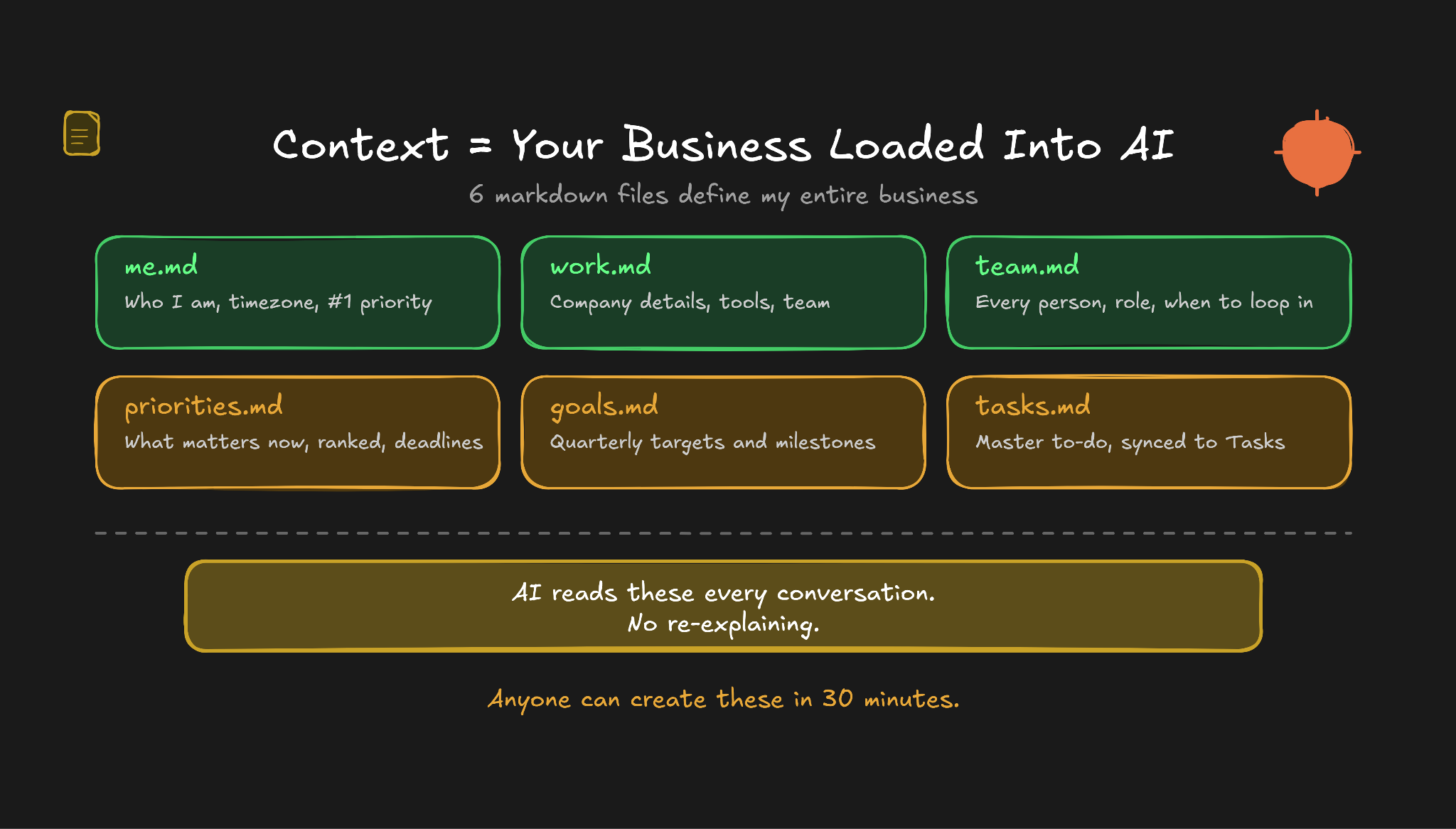
His solution is six essential Markdown files:
他的解决方案是六个必备的 Markdown 文档:
work.md: what the company does, main business lines, core products/services, and target marketwork.md:公司做什幺、主要业务线、内核产品/服务、目标市场team.md: team roster, each person's responsibilities, communication preferences, and time zonesteam.md:团队名单、每个人的职责、沟通偏好和时区priorities.md: current top projects, short-term and long-term goals, what can wait vs. what needs immediate actionpriorities.md:当前优先项目、短期和长期目标、可以等待的事项与需要立即行动的事项goals.md: annual targets, quarterly OKRs, key metrics, and the definition of successgoals.md:年度目标、季度 OKR、关键指标和成功的定义rules.md: code style guides, communication norms, decision processes, and non-negotiable principlesrules.md:代码风格指南、沟通规范、决策流程和不可妥协的原则tasks.md: to-dos, in-progress projects, completed tasks, and task dependenciestasks.md:待办事项、进行中的项目、已完成任务和任务依赖关系All six are mandatory.
六个文档缺一不可。
"All six files must be in place, or it's not truly useful. Because if any one is missing, say goals are missing, then the AI agent really doesn't know what you're actually pursuing."
"六个文档必须全部到位,否则就不会真正有用。因为如果缺少任何一个,比如缺少 goals,那 AI 智能体就真的不知道你在追求什幺。"
Without work.md, the agent doesn't know what you do and its suggestions may be completely off-topic. Without team.md, it won't know who to contact or may use the wrong communication style. Without priorities.md, it can't distinguish what's urgent from what's trivial. Without goals.md, it can't judge whether an action helps achieve objectives. Without rules.md, it may violate company standards. Without tasks.md, it duplicates work or misses critical items.
没有 work.md,智能体不知道你做什幺,建议可能完全跑题。没有 team.md,它不知道该联系谁,或者用错沟通方式。没有 priorities.md,它无法区分紧急和琐碎。没有 goals.md,它无法判断某个行动是否有助于实现目标。没有 rules.md,它可能违反公司标准。没有 tasks.md,它会重复工作或遗漏关键事项。
This is the memory foundation for agents. Without these, an agent is just a clever tool, not an assistant that truly understands your business.
这是智能体的记忆基础。没有这些,智能体只是一个聪明的工具,而不是一个真正理解你业务的助手。
Seb spent significant time building skill chains that fall into three categories.
Seb 花了大量时间构建技能链,分为三个类别。
These are the core skills agents use every day: /gm (Good Morning) generates the morning summary, /eod (End of Day) creates the daily report, /todo generates the to-do list, and /prep prepares meetings.
这些是智能体每天使用的内核技能:/gm(早安)生成晨间摘要,/eod(收工)创建日报,/todo 生成待办清单,/prep 准备会议。
/prep is particularly important:
/prep 尤其重要:
"The prep is basically when I have a call with someone important, I want to call back on the manager's memory on everything I know about the person and the business, and it impresses me on what I can say during the call."
"prep 基本上就是当我要和重要的人通话时,我想调用管理者的记忆,回顾我所知道的关于这个人和这家公司的一切,让我在通话中知道该说什幺。"
The /prep skill outputs complete meeting preparation materials: key information (last meeting date, discussion topics, budget range, decision timeline), the counterpart's traits (what they value, interests, decision style), suggested talking points, and potential questions with response strategies.
/prep 技能输出完整的会议准备材料:关键信息(上次会议日期、讨论话题、预算范围、决策时间线),对方的特征(他们看重什幺、兴趣、决策风格),建议的谈话要点,以及潜在问题和应对策略。
It's like having a senior consultant doing exhaustive prep work before every important meeting.
就像每次重要会议前都有一位资深顾问做详尽的准备工作。
This is the most powerful skill chain, designed for complex tasks. The flow has five steps:
这是最强大的技能链,专为复杂任务设计。流程有五个步骤:
Seb gave a practical example:
Seb 给出了一个实际例子:
"Let's say I need to do a slide for this AI agent workshop. I basically ask the agent to investigate what is even going on, what is this workshop about. It will scan the document, scan how others are doing it in other agency workshops, then try to simulate their workflow and create a script."
"比如说我需要为这个 AI 智能体 workshop 做一份幻灯片。我基本上让智能体去调查发生了什幺、这个 workshop 是关于什幺的。它会扫描文档,查看其他 workshop 是怎幺做的,然后模拟他们的工作流并创建一个脚本。"
The agent proactively researches, analyzes, thinks, and generates a complete plan. This isn't simple command execution; it's genuine reasoning.
智能体主动调研、分析、思考,并生成完整的计划。这不是简单的命令执行,而是真正的推理。
Of all skills, Seb considers /audit the most important.
在所有技能中,Seb 认为 /audit 最重要。
"This audit is probably one of my number one command call for the entire stack."
"这个 audit 可能是我整个技术栈中排名第一的命令调用。"
Why is auditing so crucial?
为什幺审计如此关键?
"90% of the builders over here, once you have built everything, you will probably just say 'Oh this is OK, I'm gonna stop here.' But that is the wrong step. You cannot take the agent's work on the first pass."
"在座 90% 的构建者,一旦构建完所有东西,可能就会说'哦,这没问题,我就停在这里了。'但这是错误的做法。你不能只接受智能体第一次的产出。"
Most developers accept an agent's first output, but this often leads to bugs. Seb's audit workflow reviews from three angles: functionality (does it achieve the goal?), quality (is the code or content high-quality?), and best practices (does it meet standards?).
大多数开发者会接受智能体的第一次产出,但这往往导致 bug。Seb 的审计工作流从三个角度审查:功能性(是否达到目标?)、质量(代码或内容质量高吗?)、最佳实践(是否符合标准?)。
If issues are found, the /fix skill auto-repairs, then re-audits, looping three times or until clean.
如果发现问题,/fix 技能会自动修复,然后重新审计,循环三次或直到无问题。
"This actually reduces the first five times that you break to maybe until the first time it breaks, and everything else is pretty small issues."
"这实际上把你最初五次崩溃减少到也许只有第一次崩溃,其余的都是小问题。"
This simple audit loop dramatically reduces bug count. Most developers accept the first output and hit frequent bugs. Seb's agents auto-audit 3 times, and the issues become far fewer.
这个简单的审计循环大幅减少了 bug 数量。大多数开发者接受第一次产出并频繁遇到 bug。Seb 的智能体自动审计 3 次,问题变得少得多。
You cannot take the agent's work on the first pass. 90% of builders stop too early.
你不能只接受智能体第一次的产出。90% 的建造者停得太早。
Seb emphasized the importance of tool calling:
Seb 强调了工具调用的重要性:
"Tool calling is probably one of the number one important use cases that you should definitely implement in all your agents."
"工具调用可能是你绝对应该在所有智能体中实现的最重要的用例之一。"
Why?
为什幺?
"If you want to make your OpenClaw useful, you want to have it edit your Google Docs or any PowerPoint slides. If you're not connected to the MCP or API, it can't do that for you."
"如果你想让你的 OpenClaw 真正有用,你会希望它能编辑你的 Google Docs 或任何 PowerPoint 幻灯片。如果没有连接 MCP 或 API,它做不到。"
Without tool calling, agents can only chat. They can't act. Seb's tool stack includes Telegram API (Tom sends messages), Typefully (Cindy publishes social media), Google Workspace (editing docs and sheets), Custom CRM API (accessing client data), and various data APIs (fetching market data).
没有工具调用,智能体只能聊天,无法行动。Seb 的工具栈包括 Telegram API(Tom 发消息)、Typefully(Cindy 发布社交媒体)、Google Workspace(编辑文档和表格)、自定义 CRM API(访问客户数据),以及各种数据 API(获取市场数据)。
Tool calling is the key step in evolving an agent from "chatbot" to "virtual employee."
工具调用是智能体从"聊天机器人"进化为"虚拟员工"的关键一步。
Seb's entire day is orchestrated by agents.
Seb 的整天都由智能体编排。
"This is actually really useful. And if you configure it correctly, it's actually a pretty automated process to do everything for you."
"这真的非常有用。如果你配置正确,它实际上是一个相当自动化的流程,帮你做所有事情。"
This isn't science fiction. This is Seb's real life, every single day.
这不是科幻小说。这是 Seb 的真实生活,每一天都是如此。
Seb built a recursive learning system.
Seb 构建了一个递归学习系统。
"Every time you fix a bug in the audit cycle, you should have a little note telling the agent: every time you fix a bug, you should record the lesson in this lessons.md file."
"每次在审计循环中修复一个 bug,你都应该有一个小提示告诉智能体:每次修复 bug,都应该把教训记录到 lessons.md 文档中。"
The workflow: agent makes a mistake → /audit finds the issue → /fix repairs the bug → auto-records to lessons.md (e.g., "When implementing OAuth, always validate redirect URIs") → next time a similar situation arises, the agent reads lessons.md and avoids repeating the same error.
工作流程:智能体犯错 → /audit 发现问题 → /fix 修复 bug → 自动记录到 lessons.md(如"实现 OAuth 时,始终验证重定向 URI")→ 下次遇到类似情况,智能体读取 lessons.md 并避免重复同样的错误。
This is recursive learning: agents learn from mistakes and don't repeat them.
这就是递归学习:智能体从错误中学习,不再重蹈覆辙。
"Decision logs is basically a log of your own behavior, how you prompt the agent."
"决策日志基本上是记录你自己行为的日志,记录你如何给智能体下指令。"
It records how you prompt the agent, your preferences and habits, which instructions worked and which didn't. The agent learns your communication patterns.
它记录你如何给智能体下指令、你的偏好和习惯、哪些指令有效哪些无效。智能体学习你的沟通模式。
Initially, when you say "call memory," the agent loads all memory files. After learning, you say the same thing and the agent only loads relevant ones, because decision_logs has tracked what you usually want.
最初,当你说"调用记忆"时,智能体会加载所有记忆文档。学习之后,你说同样的话,智能体只会加载相关的文档,因为 decision_logs 已经追踪了你通常需要什幺。
Most people's agent memory is flat, everything dumped into one file. Seb sees this as suboptimal.
大多数人的智能体记忆是扁平的,所有东西都堆在一个文档里。Seb 认为这不是最优的。
"Most of the time your agent memory is just gonna be maybe one layer... But that is actually not the ideal way to do it."
"大多数时候你的智能体记忆可能只有一层……但这实际上不是理想的做法。"
The right approach is hierarchical: a global memory.md at the project root, then each client gets its own folder with a dedicated memory.md.
正确的方法是层级化的:在项目根目录有一个全局 memory.md,然后每个客户有自己的文档夹和专属的 memory.md。
"Whenever I need to call upon one client's memory, the agent will find the correct client, call upon the memory, and actually remember the last things we have spoken about: what's the context, how much dollar value is this deal, what's the next step going forward."
"每当我需要调用一个客户的记忆时,智能体会找到正确的客户,调用记忆,并实际记住我们上次谈话的内容:上下文是什幺,这笔交易价值多少,下一步该怎幺走。"
When Seb says "Tom, prepare for the meeting with ABC Corp," Tom identifies the client, navigates to /clients/abc_corp/memory.md, reads the last meeting date, discussion topics, deal size, next steps, and contact info — then generates prep materials. Instead of reading all 6,000 contacts' memory, mixing up different clients, and causing information overload.
当 Seb 说"Tom,为与 ABC 公司的会议做准备"时,Tom 识别客户,导航到 /clients/abc_corp/memory.md,读取上次会议日期、讨论话题、交易规模、下一步行动和联系信息——然后生成准备材料。而不是读取所有 6,000 个联系人的记忆,混淆不同客户,造成信息过载。
After years in the industry, Seb had accumulated massive contact lists:
在行业深耕多年后,Seb 积累了海量的联系人列表:
"Over the years I've been in this industry, I created an entire suite of clients, companies, and contact lists through my BD work... 6,000-plus contacts and 600-plus companies."
"多年来在这个行业,我通过 BD 工作创建了一整套客户、公司和联系人列表……6,000 多个联系人和 600 多家公司。"
The problem? Data scattered across multiple Excel files and Google Sheets, difficult to search and update, no interaction history tracking, and missed opportunities.
问题是什幺?数据分散在多个 Excel 文档和 Google Sheets 中,难以搜索和更新,没有互动历史追踪,错失商机。
"I basically condensed all of these into a comprehensive database to ensure I can use an agent to build a CRM platform for me."
"我基本上把所有这些集成到一个综合数据库中,确保我可以用智能体为我构建一个 CRM 平台。"
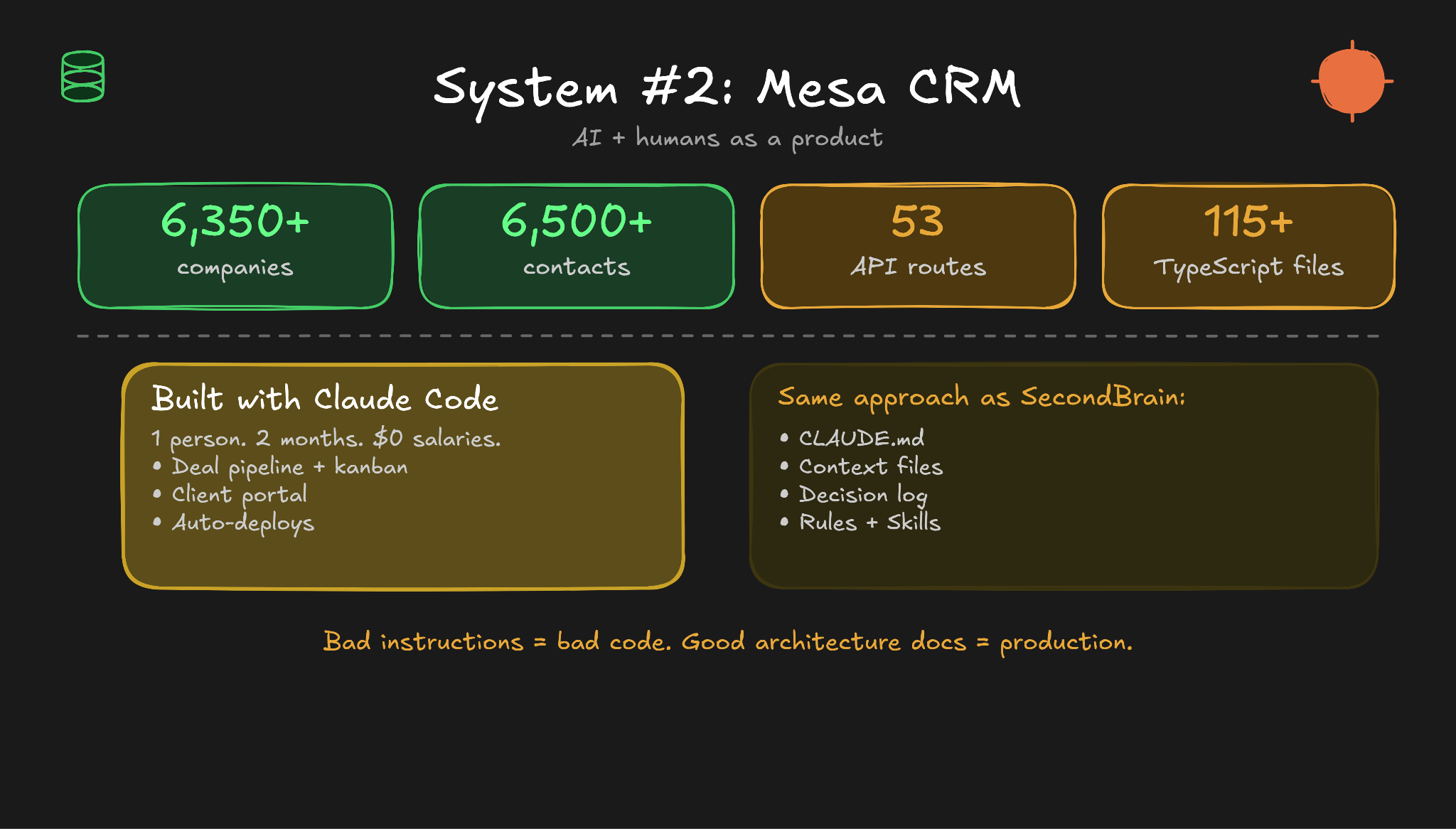
The numbers:
数据一览:
Built with Claude Code. One person. Two months. $0 in developer salaries. Deal pipeline + kanban. Client portal. Auto-deploys.
用 Claude Code 构建。一个人。两个月。开发者薪资 0 美元。交易管道 + 看板。客户门户。自动部署。
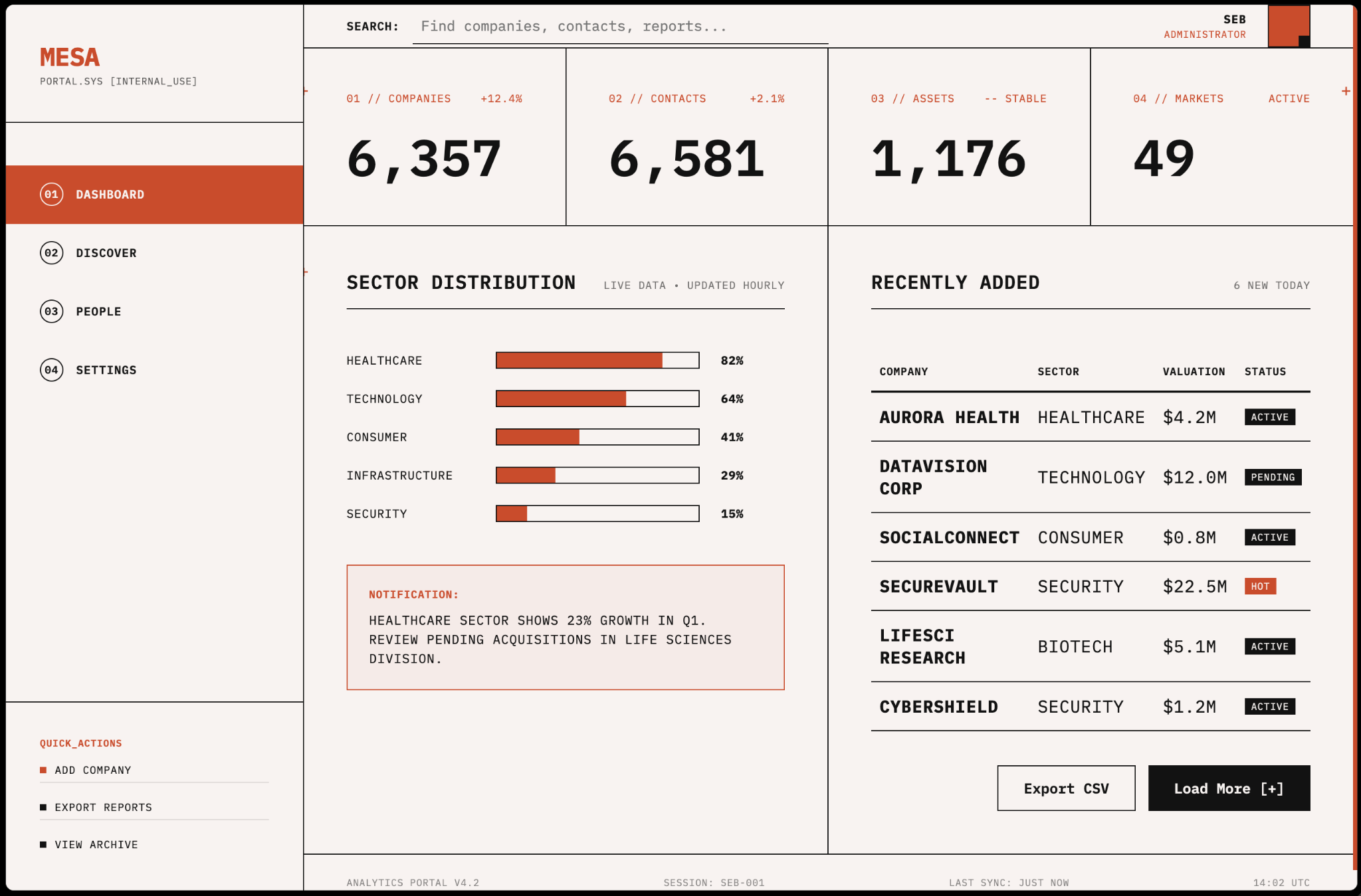
The most remarkable part: the entire system was built by AI.
最了不起的部分:整个系统都是由 AI 构建的。
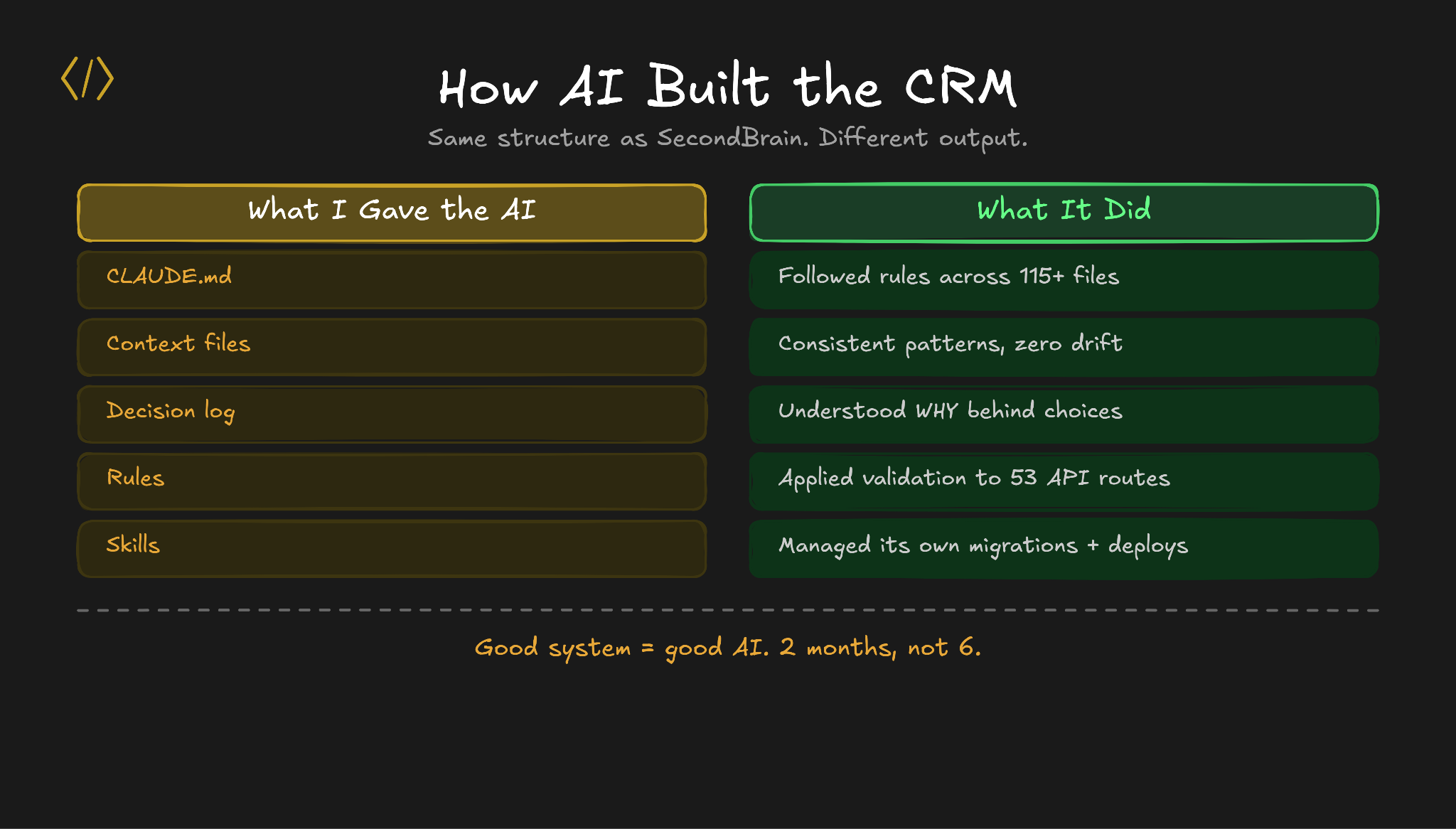
What Seb gave the AI: CLAUDE.md, context files, decision log, rules, and skills.
Seb 给 AI 的输入:CLAUDE.md、上下文文档、决策日志、规则和技能。
What it built: followed rules across 115+ files, maintained consistent patterns with zero drift, understood the reasoning behind choices, applied validation across 53 API routes, and managed its own migrations + deploys.
它构建的产出:在 115+ 个文档中遵循规则,保持一致的模式且零偏差,理解选择背后的推理,在 53 条 API 路由中应用验证,并自主管理迁移和部署。
Good systems = good AI. Two months, not six.
好的系统 = 好的 AI。两个月,而非六个月。
"The entire process was 100% built by AI... I built it myself, I just used Copilot... So I paid $100 for Copilot. Based on the work Copilot actually output for me, it's still 100% worth it."
"整个过程 100% 由 AI 构建……我自己做的,只是用了 Copilot……所以我为 Copilot 付了 100 美元。基于 Copilot 实际为我产出的工作,这 100% 值得。"
Traditional approach: hire developers for $10,000-$25,000, wait 3-6 months, deal with ongoing maintenance. AI approach (Claude + Copilot): $100/month, done in days to weeks (iterate as you go), AI handles updates anytime.
传统方式:聘请开发者花 10,000-25,000 美元,等待 3-6 个月,处理持续维护。AI 方式(Claude + Copilot):每月 100 美元,数天到数周完成(边做边迭代),AI 随时处理更新。
"I think this Copilot can probably replace my senior engineer for maybe 3 months."
"我觉得这个 Copilot 大概能替代我的高级工程师大约 3 个月。"
The CRM system spans 400+ files and exceeds 1 GB in size. Features include contact management, company database, interaction history tracking, task and follow-up reminders, reports and analytics, and role-based access control.
CRM 系统涵盖 400+ 个文档,超过 1 GB 大小。功能包括联系人管理、公司数据库、互动历史追踪、任务和跟进提醒、报告和分析,以及基于角色的访问控制。
The CRM has a three-tier permission system:
CRM 有一个三级权限系统:
"There's gonna be managers, assistant, or whatever role, then there's gonna be admin... So you have to configure everything correctly so that your access doesn't get leaked to other roles that aren't relevant."
"会有经理、助理或其他角色,然后还有管理员……所以你必须正确配置所有内容,确保你的权限不会泄漏给不相关的角色。"
"Please make sure that they can only append the database and not delete or do anything destructive to it."
"请确保他们只能追加数据库内容,不能删除或做任何破坏性操作。"
This protects against accidental deletion of critical data, controls sensitive information access, and tracks who did what.
这可以防止意外删除关键数据、控制敏感信息访问,并追踪谁做了什幺。
Seb has a clear-eyed view of how AI and humans should divide work:
Seb 对 AI 和人类应该如何分工有清醒的认识:
"You cannot 100% remove any human... AI agent is not really smart enough to sometimes think out of the box or find certain solutions that for humans are a no-brainer thing."
"你不可能 100% 去掉人类……AI 智能体还不够聪明,有时无法跳出框架思考,或者找到对人类来说显而易见的解决方案。"
AI handles automation: daily ops, scheduling, content drafting, market research.
AI 负责自动化:日常运营、日程安排、内容起草、市场调研。
Humans handle judgment: verifying data accuracy, reviewing potential clients, collecting private data, final decisions.
人类负责判断:验证数据准确性、审核潜在客户、采集私域数据、最终决策。
"If the data is not correct, then it's gonna be useless and corrupt my entire database. So I need to ask the human to verify the leads, collect private data from other sources online, or maybe from Telegram groups or WhatsApp."
"如果数据不正确,那就毫无用处,还会污染我整个数据库。所以我需要让人类去验证线索,从其他在线来源采集私域数据,或者从 Telegram 群组或 WhatsApp 中获取。"
Scenarios where humans can't be replaced: private group information (Telegram, WhatsApp), relationship-dependent situations, creative and strategic decisions, and quality control with final review.
人类不可替代的场景:私域群组信息(Telegram、WhatsApp),依赖关系的场景,创意和战略决策,以及最终审核的质量控制。
"Make sure that every single AI you have implemented has full context of what you want to do, what your goals are, what your tasks are, who your team members are."
"确保你部署的每一个 AI 都有完整的上下文:你想做什幺、你的目标是什幺、你的任务是什幺、你的团队成员是谁。"
The six essential files (work.md, team.md, priorities.md, goals.md, rules.md, tasks.md) provide this context.
六个内核文档(work.md、team.md、priorities.md、goals.md、rules.md、tasks.md)提供了这些上下文。
"Make sure the agent's soul is actually well defined. Because if you configure the agent soul as someone who is lazy, then of course it's gonna be lazy."
"确保智能体的灵魂被明确定义。因为如果你把智能体的灵魂配置成一个懒惰的人,那它当然会懒惰。"
Seb's agent "soul" definition: "You are a hardworking, intelligent assistant that will be helpful to me to the utmost extent. You think carefully before acting, you verify information from reliable sources, and you always aim for excellence in your work."
Seb 的智能体"灵魂"定义:"你是一个勤奋、聪明的助手,将尽最大努力帮助我。你在行动前仔细思考,从可靠来源验证信息,并始终追求卓越。"
"Never blindly trust the agent's code. You don't want to let it destroy your codebase and maybe your SOPs as well."
"永远不要盲目信任智能体的代码。你不会想让它毁掉你的代码库,也许还有你的标准操作流程。"
Audit everything: code, content, data, decisions.
审计一切:代码、内容、数据、决策。
"Don't skip memory. This is crucial."
"不要跳过记忆。这至关重要。"
No memory means starting from zero every time, wasting both time and money.
没有记忆意味着每次都从零开始,浪费时间和金钱。
"One agent at a time. Don't... Some of you if you are new might be overly excited and start to deploy 5 to 10 agents at a time, which is not the way to go."
"一次一个智能体。不要……你们中有些新手可能过于兴奋,一次就部署 5 到 10 个智能体,这是不对的。"
"If you have too many agents then you may not have configured them in integrity or memory or the software properly yet, and then they may co-mingle with each other which is gonna be a big issue moving down the road."
"如果你有太多智能体,你可能还没有正确配置它们的完整性、记忆或软件,然后它们可能会互相干扰,这在未来会是个大问题。"
The right sequence: configure the first agent (e.g., Tom) → test and optimize → ensure stable operation → add the second agent (e.g., Jerry) → confirm they collaborate well → then continue adding more.
正确的顺序:配置第一个智能体(如 Tom)→ 测试和优化 → 确保稳定运行 → 添加第二个智能体(如 Jerry)→ 确认它们协作良好 → 然后继续添加更多。
One agent at a time. Configure, stabilize, then add the next. Five at once is chaos.
一次一个智能体。先配置、稳定、再加下一个。一次五个就是混乱。
"If you look back from now to two years back, all the businesses are 100% manual... But you look at two years down the road, which is now, a lot of people are really getting fired by AI — that's just a fact. Amazon is cutting 10K workers, Microsoft cutting 20K."
"如果你从现在回看两年前,所有业务都是 100% 手动的……但你再看两年后的现在,很多人确实被 AI 取代了——这是事实。亚马逊裁员 1 万人,微软裁员 2 万人。"
Two years ago (2024): business was 100% manual. AI existed but wasn't widely deployed.
两年前(2024):业务 100% 手动。AI 存在但没有广泛部署。
Now (2026): AI is starting to replace jobs. Mass layoffs are happening.
现在(2026):AI 正在开始取代岗位。大规模裁员正在发生。
Two years from now (2028): Seb predicts 90% of decisions will be made by AI. Humans will only correct AI. Those who don't adapt will be eliminated.
两年后(2028):Seb 预测 90% 的决策将由 AI 做出。人类只负责纠正 AI。不适应的人将被淘汰。
How to avoid being replaced by AI?
如何避免被 AI 取代?
"The only way you can make yourself not replaced by AI is to make sure that you understand AI and you yourself can implement AI as a tool... AI is just a tool. If you don't want to see AI replace you, then you must not be just a tool."
"让自己不被 AI 取代的唯一方法,是确保你理解 AI 并且你自己能把 AI 当工具使用……AI 只是一个工具。如果你不想被 AI 取代,那你就不能只当一个工具。"
The survival playbook is simple: learn to use AI, let AI amplify your capabilities, become AI's manager — not its competitor.
生存策略很简单:学会使用 AI,让 AI 放大你的能力,成为 AI 的管理者——而不是它的竞争者。
Seb's tech stack:
Seb 的技术栈:
Agent platforms: OpenClaw (primary framework), Claude Code (code generation), GitHub Copilot ($100/mo).
智能体平台:OpenClaw(主框架)、Claude Code(代码生成)、GitHub Copilot($100/月)。
Tool integrations: Telegram Bot API, Typefully (social media), Google Workspace API, Custom CRM API.
工具集成:Telegram Bot API、Typefully(社交媒体)、Google Workspace API、自定义 CRM API。
Infrastructure: Windows Server (home desktop), VS Code + Remote Tunnel (connect anytime), Mobile VS Code (phone access).
基础设施:Windows Server(家用台式机)、VS Code + Remote Tunnel(随时连接)、移动端 VS Code(手机访问)。
Total cost: ~$300/month (Claude Code Pro ~$150, GitHub Copilot $100, other tools $50). Compared to the $8,600/month saved ($11,000 down to $2,400), that's an ROI of 2,867%.
总成本:约 $300/月(Claude Code Pro 约 $150、GitHub Copilot $100、其他工具 $50)。相比每月节省的 $8,600(从 $11,000 降至 $2,400),投资回报率为 2,867%。
From $11,000 to $2,400/month. Not projections, actual operating numbers. Smart hiring across Southeast Asia combined with AI agents creates an unbeatable cost structure.
从每月 $11,000 到 $2,400。不是预测,是实际运营数字。在东南亚智能招聘结合 AI 智能体,打造了无可匹敌的成本结构。
Tom coordinates and schedules. Jerry ensures all data is source-verified, eliminating assumptions. Cindy learns your voice and auto-publishes. Each has a soul, a skill set, and a schedule.
Tom 协调和安排日程。Jerry 确保所有数据有来源验证,消除假设。Cindy 学习你的语气并自动发布。每个都有灵魂、技能集和时间表。
work.md, team.md, priorities.md, goals.md, rules.md, tasks.md. Miss one and the agent operates blind in that dimension. All six are mandatory.
work.md、team.md、priorities.md、goals.md、rules.md、tasks.md。缺少一个,智能体就在那个维度上是盲的。六个缺一不可。
Never accept the first pass. The /audit → /fix loop running 3 times dramatically reduces bugs. 90% of builders stop too early. Don't be one of them.
永远不要接受第一次的产出。/audit → /fix 循环运行 3 次可以大幅减少 bug。90% 的构建者过早停下。不要成为其中之一。
6,350+ companies, 53 API routes, 115+ TypeScript files, 400+ total files, 1GB+. Built by one person with Claude Code in two months for $100/month. Traditional cost: $10K-$25K over 3-6 months.
6,350+ 家公司,53 条 API 路由,115+ 个 TypeScript 文档,400+ 个文档,1GB+。一个人用 Claude Code 两个月构建,每月 $100。传统成本:$10K-$25K,耗时 3-6 个月。
lessons.md + decision_logs.md + hierarchical memory = agents that learn from mistakes, adapt to your patterns, and never confuse one client with another.
lessons.md + decision_logs.md + 层级化记忆 = 能从错误中学习、适应你的模式、永远不会混淆客户的智能体。
"If you don't configure your agents properly, this will happen to you."
"如果你不正确配置你的智能体,这种事就会发生在你身上。"
"The problem with agents is most of them like to make assumptions. When they make assumptions, you don't know."
"智能体的问题是大多数都喜欢做假设。当它们做假设时,你并不知道。"
"You cannot take the agent's work on the first pass. You always have to run multiple rounds of audit and review."
"你不能只接受智能体第一次的产出。你必须始终运行多轮审计和复查。"
"AI is just a tool. If you don't want to see AI replace you, then you must not be just a tool."
"AI 只是一个工具。如果你不想被 AI 取代,那你就不能只当一个工具。"
"Context is everything. Agents must know their real jobs. Make sure they are well-defined and properly connected to your tools."
"上下文就是一切。智能体必须知道它们真正的工作。确保它们被明确定义并正确连接到你的工具。"
What Seb showed on stage isn't a vision of the future. It's the present. Every morning at 8 AM, Tom sends a briefing. Before every meeting, /prep generates materials. Every tweet Cindy publishes. Every data point Jerry verifies. All real. All running. All creating value.
Seb 在台上展示的不是未来的愿景,而是当下。每天早上 8 点,Tom 发送简报。每次会议前,/prep 生成材料。Cindy 发布的每条推文。Jerry 验证的每个数据点。全部真实。全部运行中。全部在创造价值。
From a 17-person team to AI-powered lean ops. From $11,000/month to $2,400. From managing one company to running two simultaneously. This is what happens when AI agents actually start working.
从 17 人团队到 AI 驱动的精益运营。从每月 $11,000 到 $2,400。从管理一家公司到同时经营两家。这就是当 AI 智能体真正开始工作时会发生的事。
Not replacing humans, but augmenting them. Not eliminating work, but eliminating repetition. Not making CEOs obsolete, but freeing CEOs to do what only humans can: strategic thinking, creative decisions, building relationships.
不是取代人类,而是增强人类。不是消除工作,而是消除重复。不是让 CEO 过时,而是解放 CEO 去做只有人类才能做的事:战略思考、创意决策、创建关系。
The value of this talk isn't telling you AI is powerful; that's common knowledge. The value is laying out a complete, replicable, battle-tested system architecture. From memory files to skill chains, tool integrations to access control, audit loops to hierarchical memory. Every detail forged in the field.
这次分享的价值不在于告诉你 AI 很强大——这已经是常识。价值在于展示了一套完整的、可复制的、实战验证过的系统架构。从记忆文档到技能链,从工具集成到访问控制,从审计循环到层级化记忆。每个细节都在实战中锻造。
Now it's your turn. Pick your first task to automate. Create six memory files. Define your first agent's soul. Set budget limits. Start building.
现在轮到你了。选择你的第一个自动化任务。创建六个记忆文档。定义你第一个智能体的灵魂。设置预算限制。开始构建。
One agent at a time. One step at a time.
一次一个智能体。一次一步。